
herbata liściasta
What do OP, BOP, FOP, FBOP and other abbreviations on tea packaging mean?
OP, BOP, FOP, FBOP, fannings and dust explained. Find out what the abbreviations on tea packaging mean and why they are not a simple quality scale.
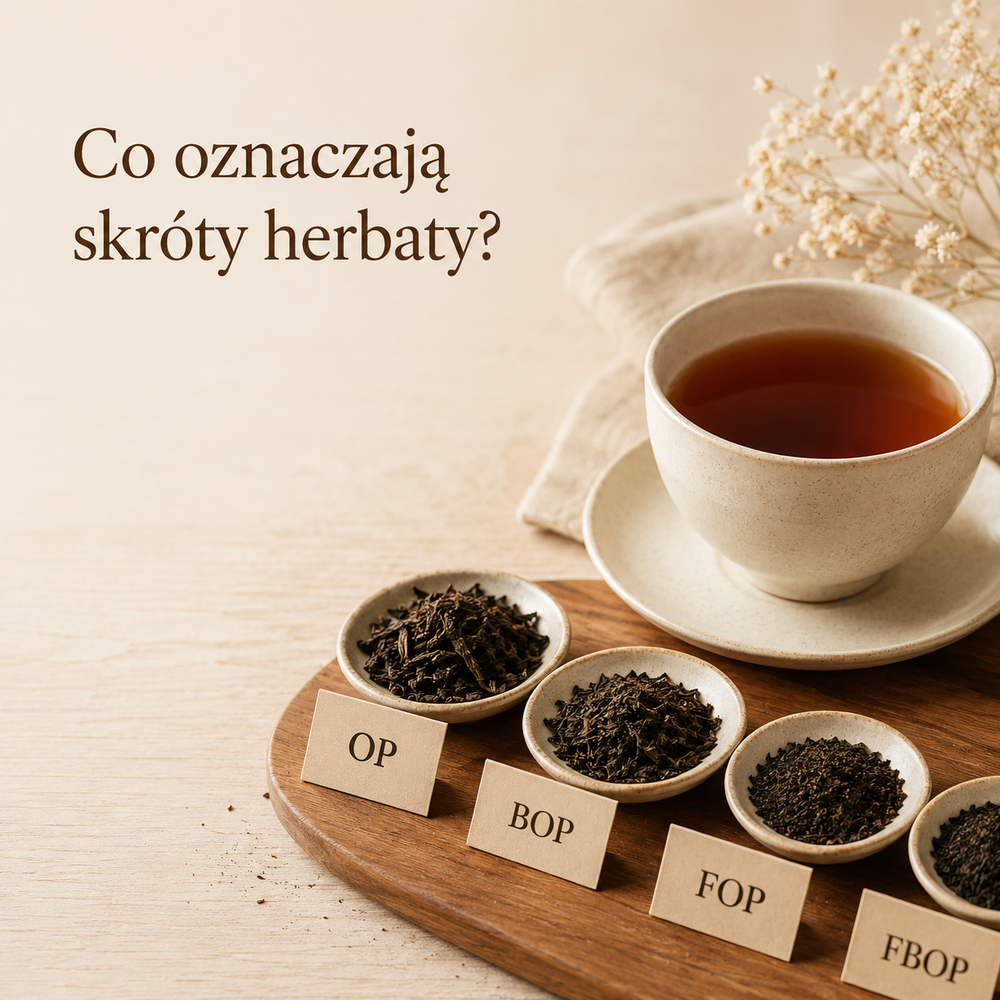
OP, BOP, FOP, FBOP, and similar abbreviations are designations used to describe the sorting method and appearance of tea leaves, especially in systems related to black teas produced by the orthodox method. They are not a simple quality scale from worst to best and do not, on their own, tell you whether you will like a particular tea.
The most important thing is to distinguish between two things. The leaf grade designation primarily describes the size, degree of comminution, and presence of young tips. The quality of the infusion, however, also depends on the raw material, cultivation location, harvest season, production method, freshness, and the producer's skill.
You will most often encounter these abbreviations on loose leaf black teas, especially those from Sri Lanka, India, and other regions where such classifications are traditionally used.
In brief: what do the most popular abbreviations mean?
| Abbreviation | Full Name | What does it usually describe? |
|---|---|---|
| OP | Orange Pekoe | Whole, relatively long leaves |
| FOP | Flowery Orange Pekoe | Whole leaves with young tips |
| GFOP | Golden Flowery Orange Pekoe | FOP with a noticeable presence of golden tips |
| TGFOP | Tippy Golden Flowery Orange Pekoe | Leaves with a higher proportion of tips |
| BOP | Broken Orange Pekoe | Broken leaves, smaller than whole leaf grades |
| FBOP | Flowery Broken Orange Pekoe | Broken leaves with tips |
| BOPF | Broken Orange Pekoe Fannings | Finer leaf particles |
| Fannings | Fannings | Very fine leaf fragments |
| Dust | Dust | Finest particles, quickly releasing flavor |
Nomenclature may vary between countries, plantations, and producers. Not every abbreviation is used identically everywhere, and not every tea uses this system at all.

What does OP, or Orange Pekoe, mean?
OP stands for Orange Pekoe. It most often refers to tea made from whole, relatively long leaves. Important note: the word "Orange" does not mean oranges or an orange flavor.
Orange Pekoe is a historical classification term. Therefore, OP may appear on the packaging even if the tea contains no orange peel, citrus aroma, or flavorings.
This is one of the most common interpretive traps. The consumer sees "Orange" and expects a flavored tea, while the producer is simply describing the leaf grade.
What does FOP mean?
FOP is Flowery Orange Pekoe. In this case, the term "Flowery" refers to the presence of younger shoot parts and tips, not a floral aroma added to the tea.
Compared to basic OP, the FOP designation suggests the inclusion of more delicate, young leaf parts. However, it is still not a guarantee of a specific taste or an automatic assessment of the overall product quality.
What do GFOP, TGFOP, and FTGFOP mean?
In more elaborate classifications, additional letters appear. Most commonly, you will encounter, among others:
- GFOP - Golden Flowery Orange Pekoe,
- TGFOP - Tippy Golden Flowery Orange Pekoe,
- FTGFOP - Finest Tippy Golden Flowery Orange Pekoe.
The words "Golden" and "Tippy" refer to the presence of light or golden tips, i.e., young buds and shoot ends visible in the dry tea. The more elaborate the designation, the more information the producer tries to convey about the character of the grade.
However, these abbreviations should not be treated as a universal scoring system. Individual regions and plantations may use nomenclature with their own nuances, and the beautiful appearance of tips does not replace the quality of the raw material and proper production process.
What does BOP mean?
BOP stands for Broken Orange Pekoe, which refers to a grade of broken leaves. The particles are smaller than in typical OP, so they have a larger contact surface with water and usually release infusion components more quickly.
This does not mean that BOP is a "worse tea." Fragmentation primarily affects the extraction method. A good BOP tea can yield an intense, aromatic, and full-bodied infusion that is excellent for those who prefer bolder black teas.
For the same weight of dry tea and similar conditions, finer leaves may brew faster than whole leaves. Therefore, when switching from OP to BOP, it's worth monitoring the brewing time instead of automatically using the exact same parameters.
What does FBOP mean?
FBOP stands for Flowery Broken Orange Pekoe. This is a tea made from broken leaves, which also contains younger parts and tips.
As with FOP, the word "Flowery" does not mean an added floral aroma. It is an element of the classification name referring to the appearance and composition of the grade.
What are Fannings and Dust?
Fannings and Dust are very fine fractions of tea leaves. Due to their small size, they quickly release color and flavor into the water. For this reason, they often work well in tea bags, where a short brewing time is expected.
A fine fraction is not in itself proof of low quality. The origin of the raw material and the production method are important. At the same time, the brewing method should be adapted to the leaf size, as fine tea can quickly become very intense.
Does a larger leaf always mean better tea?
No. This is one of the most common oversimplifications. Large, uniform leaves can look impressive and usually brew slower, but size is not a complete measure of quality.
The final taste is influenced by, among other things:
- the variety of tea bush,
- altitude and growing region,
- harvest season,
- maturity of the harvested leaves,
- method of wilting, rolling, oxidation, and drying,
- freshness and storage of the finished tea,
- brewing method.
Therefore, OP or FOP designations should be read as one element of the product description, not a final verdict.
Is BOP worse than OP?
No. OP and BOP primarily describe the size and form of the leaf. BOP is finer and usually brews faster, while OP may release flavor more gradually.
This can lead to sensory differences, but it does not create a simple "good versus bad" hierarchy. In some tea styles, an intense infusion from a broken leaf is exactly what the producer and consumer expect.
How does the abbreviation on the packaging affect brewing?
The most practical information concerns particle size. The finer the leaf, the faster the extraction usually occurs. This means that BOP, fannings, or dust may require shorter brewing times than long, whole leaves.
If the infusion from fine tea is too bitter or astringent, try shortening the brewing time first. There's no need to immediately lower the temperature, reduce the amount of tea, and change vessels all at once.
For large whole leaves, however, space is important. A wide infuser allows them to unfurl freely and facilitates even contact with water.
Where are OP, BOP, and FOP designations most commonly found?
The system is particularly associated with black teas from India and Sri Lanka, although similar designations can also be found in other tea-producing countries. However, it is not a universal language for all teas in the world.
When comparing teas from Sri Lanka, it's worth checking out the Ceylon teas collection. On such products, in addition to the leaf grade, you may find information about the region, plantation, or production style.
For example, the name Basilur Uva black tea tin - 100 g indicates important information about the profile and origin related to the Uva region. If another tea next to the region has an OP or BOP designation, it will describe a different aspect of the product, namely the leaf sorting.
How to read designations without falling into marketing traps?
It's best to treat abbreviations as part of a larger set of information. Instead of asking only "is this FOP?", check several elements at once:
- Type of tea - black, green, white, oolong, or other.
- Origin - country, region, and sometimes plantation.
- Harvest season - if provided by the producer.
- Leaf grade - OP, FOP, BOP, and similar.
- Ingredients - especially for flavored teas and blends.
- Brewing instructions - important, because finer and larger leaves behave differently.
This approach provides much more information than just looking for the longest abbreviation on the packaging.

Does OP mean orange flavor?
No. Orange Pekoe is not a flavor name. OP tea without additives should not taste like orange just because it has this designation.
If you want to buy citrus tea, check the ingredients and product name, not the leaf grade symbol.
Does "Flowery" mean a floral taste?
Again, no. In FOP and FBOP, the word Flowery refers to younger shoot parts and tips. The tea may have natural floral notes, but the abbreviation itself does not guarantee this.
Why might two producers describe similar leaves differently?
Leaf classification is not a single global laboratory standard with identical thresholds for every country and every factory. Regional traditions and commercial systems differ, so it's best to compare designations within similar origins and production styles.
If you are primarily interested in whole leaves, a convenient starting point is the collection of loose leaf teas. Then you can pay attention to the specific grade and see how it translates to brewing and taste.
Most common mistakes when interpreting abbreviations
Treating the abbreviation as a school grade
FOP does not automatically have to be "better" than BOP in every application. These are different grades with different properties.
Confusing Orange Pekoe with orange-flavored tea
Orange here does not refer to the fruit or aroma.
Assuming the longest abbreviation means the best taste
- Choosing a selection results in a full page refresh.
- Opens in a new window.