herbata liściasta
Tea pearls - what exactly are they and why do the leaves unfurl during brewing?
What is rolled tea and why do the leaves expand so much in water? We explain the tea rolling process, the difference between oolong and blooming tea, and the brewing rules.
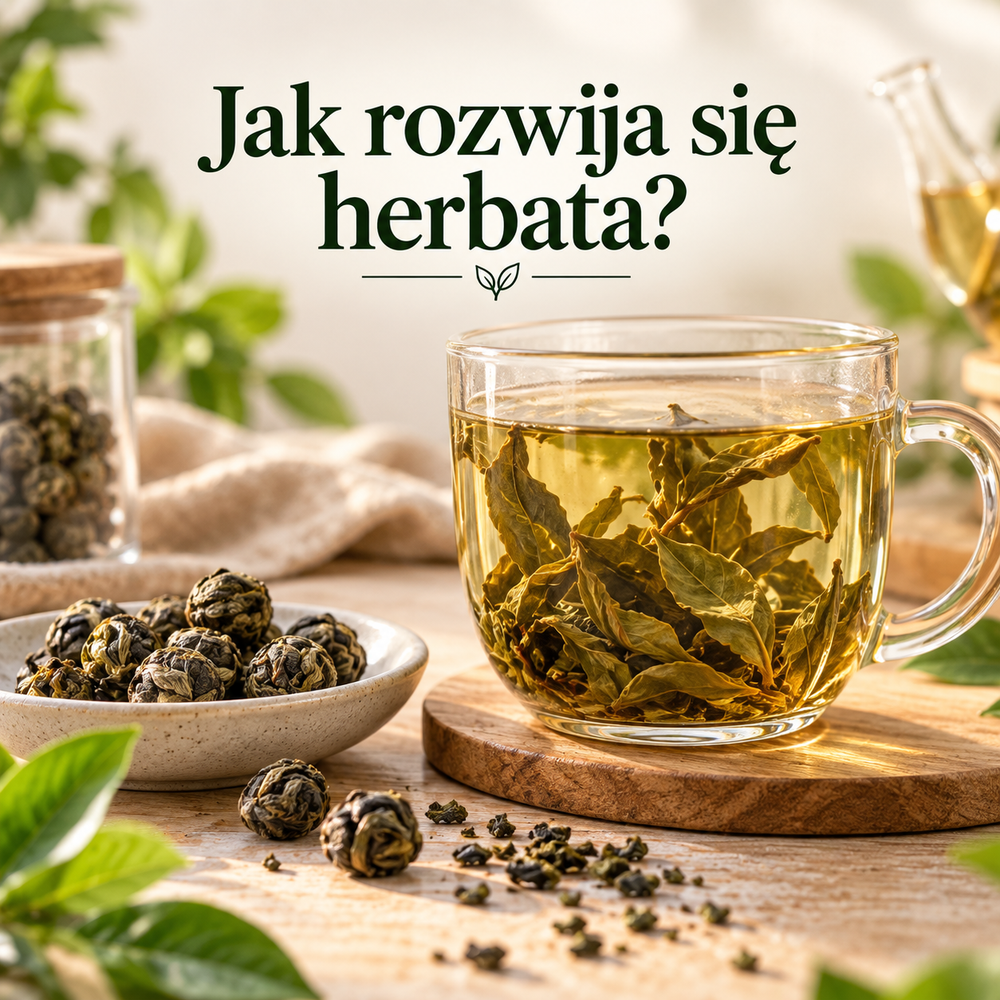
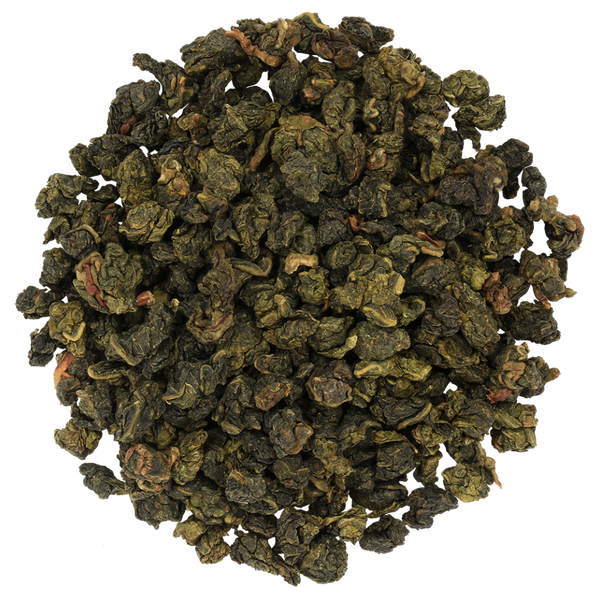
The term "ball-rolled tea" can refer to several different things. Most often, it refers to tea whose leaves have been rolled into small, compact balls or pellets during production. This is the appearance of some oolongs, among others. Upon being steeped in water, the leaves gradually loosen, increase in volume, and reveal their true shape.
It is worth distinguishing such teas from flowering teas. Rolled tea consists of individual leaves or fragments thereof formed during processing, whereas flowering tea is a hand-tied bundle of leaves and flowers that opens in water like a decorative bouquet.
In summary
- "Ball-rolled tea" most often refers to leaves rolled during production, especially in some oolong teas.
- Upon contact with hot water, the rolled leaves absorb water and gradually unfold.
- Such tea should not be forced into a small infuser, as it requires significantly more space than the dry tea suggests.
- The unfurling of leaves is a natural part of brewing and allows for easy assessment of their size and structure.
- Flowering tea is a separate category and should not be identified with ordinary ball-rolled tea.
What does "ball-rolled tea" actually mean?
Tea leaves can be formed in various ways after harvesting. Some remain relatively flat, others are twisted into thin needles, and still others are rolled into compact balls. It is the latter that are often called "ball-rolled tea" by customers.
The most characteristic examples are found among Oolong teas. In a dry state, a single portion may look inconspicuous, but after a few minutes of brewing, the balls open and transform into significantly larger leaves.
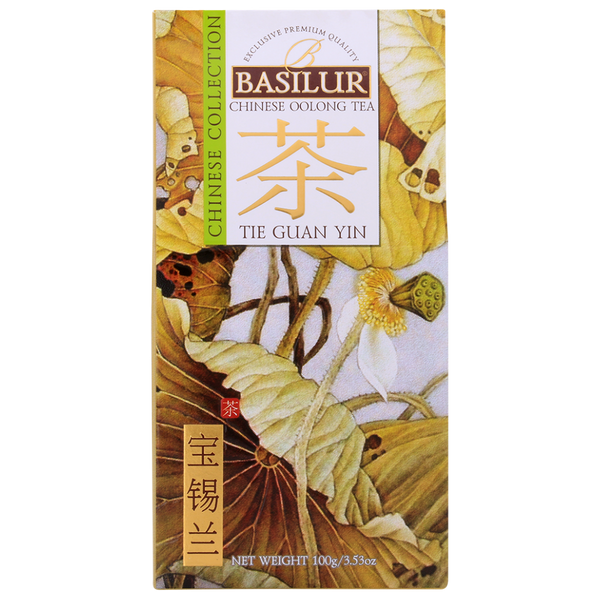
A good example of tea from this group is Basilur Chinese Collection Tie Guan Yin Oolong tea - 100 g. With such teas, it is particularly easy to see why the size of the infuser matters.
Why are the leaves rolled?
Rolling is one of the stages of tea processing. It can influence the appearance of the dry tea, the rate of aroma release, and how the leaves behave during brewing. Compact forming also facilitates packaging and ensures that the dry tea takes up less space.
This does not mean, however, that a small ball will remain small in the cup. Water penetrates between the layers of the leaf, and the structure gradually loosens. The fuller and less broken the leaf, the more noticeable the change in volume can be.
Why does the tea unfurl in water?
Dry leaves contain little water and are compact. After being submerged, they begin to absorb it. The fibers of the leaf become more flexible, and the stresses created during rolling gradually subside. Therefore, the ball opens, and the leaf returns to a much larger form.
This phenomenon is particularly striking with oolongs rolled into tight, irregular pellets. Already after the first infusion, some leaves may unfold almost completely, and with subsequent infusions, they open even further.

Does the unfurling of leaves mean the tea is of good quality?
The mere unfurling of leaves is not automatic proof of the highest quality, but it provides a lot of information about the dried product. After brewing, you can see whether the infuser contains large, whole leaves, fragments, or mostly fine material.
It is worth looking at the leaves in conjunction with other features: the aroma of the dry tea, the scent after brewing, the clarity of the infusion, the taste, and whether the tea retains its character in subsequent infusions. One element should not be the sole criterion for assessment.
How much space does ball-rolled tea need?
Much more than its dry volume suggests. This is the most important practical rule. If you pour a rolled oolong into a very small metal ball and fill it almost to the brim, the leaves may be tightly compressed after a few minutes.
A better solution is a wide basket, a larger strainer, or a teapot where the leaves can fall freely and unfold in the water. You don't need to leave the infuser empty, but there should be a clear reserve of space after adding the dry tea.
How to identify an infuser that is too small?
- after brewing, the leaves form a compact mass shaped to the walls of the strainer,
- the infuser is stuffed to the very top, even though it was only partially filled before adding water,
- some of the leaves in the center remain tightly rolled,
- the infusion turns out uneven, and the brewing time must be significantly extended,
- the tea tastes significantly better during the second infusion than the first, because the leaves only then gained enough space.
How to brew rolled oolong?
There is no single temperature or time suitable for all oolongs. Their style can be very different. A good starting point is to follow the instructions for the specific product and then adjust the parameters to your own taste.
The most important thing is that the leaves have space and that you can quickly separate them from the infusion once brewing is finished. This makes it easier to control the strength and avoid a situation where the tea steeps for much longer than intended.
Do you need to stir the leaves?
Usually, no. If the infuser is large enough, the hot water reaches the tea leaves on its own. Gently moving the vessel can help at the beginning, but there is no need to mechanically break up the balls or tear the leaves.
Can ball-rolled tea be brewed multiple times?
Many rolled oolongs are well-suited for subsequent infusions. This is when you can observe how the leaves change with each portion of water. The first infusion begins their opening, and subsequent ones allow for the utilization of an increasingly larger leaf surface.
This does not mean that every tea must taste good after a specific number of infusions. The number of successful brews depends on the specific dry tea, the amount of tea, the temperature, the time, and the volume of water.
Rolled tea vs. flowering tea - what is the difference?
These two products may look similar before adding water, but they are created differently. Rolled oolong consists of leaves shaped during production. Flowering tea, on the other hand, is a hand-tied bundle of leaves and flowers, prepared to create a decorative shape when submerged in water.
An example of the latter type is Rose Flowers Basket flowering tea - 3 pcs.. Such a product is best observed in a larger, transparent vessel, as part of the experience is the way the tied composition opens in water.
More products of this type can also be found in the white teas category, which includes selected flowering teas, among others.

Do the balls need to be crushed before brewing?
No. Rolled leaves should open on their own under the influence of water. Crushing them can damage them and cause more small fragments to enter the infusion. It is sufficient to use a sufficiently large vessel and choose the correct brewing parameters.
Most common mistakes when brewing ball-rolled tea
- An infuser that is too small. This is the most common problem. The dry portion looks small, but after soaking, it takes up several times more space.
- Filling the strainer to the brim. Leaving room for expansion is part of proper brewing.
- Crushing the balls. The leaves should unfold naturally.
- Judging the portion solely by volume. Two teaspoons of different teas can have completely different weights.
- Confusing rolled tea with flowering tea. These are different styles, and it is worth brewing them with different goals.
FAQ
Is ball-rolled tea artificially shaped?
The leaves are shaped during the production process, most often by rolling. This does not mean that artificial ingredients are added. The shape is the result of processing the dry tea itself.
Why does the ball get so big after brewing?
A dry leaf is dehydrated and rolled. After absorbing water, it becomes flexible and gradually returns to a larger form.
Is every Oolong tea rolled into balls?
No. Oolongs come in various forms. Some are rolled into compact balls, while others have more elongated or loose leaves.
Is a metal ball infuser suitable for this tea?
It may be suitable only if it is large enough relative to the portion. For tightly rolled leaves, a wide basket is usually more convenient.
Do you need to pour out the first infusion?
There is no universal rule for this. In home brewing, you can drink the first infusion as usual, unless the instructions for the specific tea or the chosen preparation method state otherwise.
Can you observe the quality of the tea by the unfolded leaves?
Yes, but only as one of several elements of the assessment. It is worth simultaneously paying attention to the aroma, taste, appearance of the infusion, and the behavior of the tea during subsequent infusions.
Summary
Ball-rolled tea is most often tea whose leaves have been rolled during production. After being submerged in water, they increase in volume and gradually open up. This is a natural phenomenon and a good reason to choose a large strainer or basket instead of a very tight infuser.
If you want to see this process using classic rolled leaves as an example, it is worth comparing different Oolong teas. For each product, start with the recommendations regarding time and temperature, and then adjust the brewing to your own taste.