herbata liściasta
Paper filter or metal infuser? Which works better for loose-leaf tea?
Paper filter or metal infuser? We compare convenience, room for leaves, cleaning, and suitability for different types of loose-leaf tea.

Both a paper filter and a metal infuser can be used for brewing loose-leaf tea. Both solutions have the same goal: to separate the leaves from the infusion at the right moment. However, they differ in convenience, the amount of space provided for the tea leaves, the cleaning process, and how well they handle fine leaf particles.
There is no single solution that is best for everyone. A paper filter works great when quick cleanup and a clear infusion are priorities. A metal infuser is more versatile, reusable, and usually gives the leaves more room. The most important thing is matching the accessory to the type of tea, the size of the vessel, and your own brewing style.
In summary
- A paper filter is convenient, disposable, and keeps out fine tea particles well.
- A metal infuser is reusable, durable, and works well for daily brewing.
- For large leaves, it is worth choosing a filter with as much capacity as possible or a wide metal basket.
- The taste of the tea depends primarily on the quality of the leaves, temperature, time, and the amount of space available for the leaves, not on the material of the infuser itself.
- If you drink tea often, a metal infuser is usually more practical. If you care about quick cleanup, paper may be more convenient.
How does a paper tea filter work?
A paper filter works similarly to a disposable tea bag, but you fill it with your chosen loose-leaf tea. After brewing, you simply take the entire filter out of the mug or teapot and discard it along with the wet tea leaves.
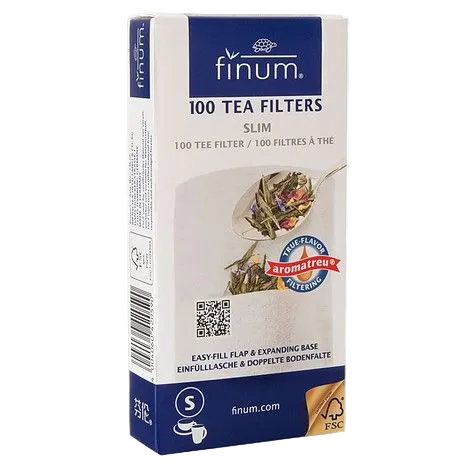
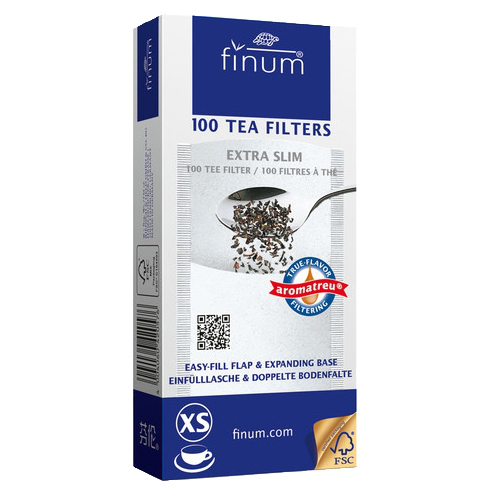
You will find various sizes of tea filters in the shop. Size matters because leaves increase in volume when they come into contact with water. The filter should not be tightly packed with dry tea. It is good if there is plenty of extra space inside after adding the tea.
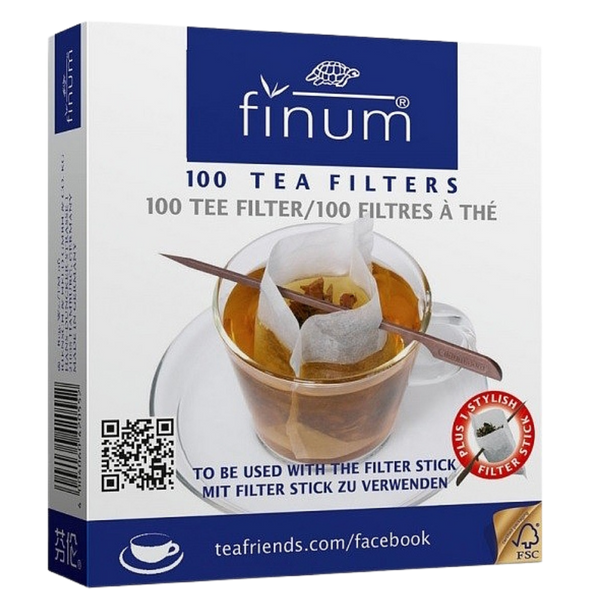
A practical solution for a daily mug is, for example, Paper tea filters + stick - 100 pieces. The stick helps keep the filter at the edge of the vessel, so there is no need to look for an extra clip.
How does a metal infuser work?
A metal infuser is a reusable strainer, basket, ball, or other perforated container for loose tea. After brewing, it is removed from the vessel, emptied, and washed. A good strainer should have enough holes for water to flow freely through the leaves.
In the infuser category, there are both small models for a single mug and larger strainers that provide the leaves with more space. An example of a more spacious design is the Strainer infuser with folding handles - Carmani.
Paper filter vs. metal infuser - the most important differences
| Feature | Paper filter | Metal infuser |
|---|---|---|
| Usage | disposable | reusable |
| Cleaning | virtually no washing required | requires emptying and washing |
| Fine tea | captures fine particles very well | depends on the mesh density |
| Space for leaves | depends on filter size | depends on design, a wide basket gives plenty of room |
| Travel convenience | very high | need to store the wet infuser later |
| Cost over time | filters must be bought regularly | one-time purchase for a longer period |

Does paper change the taste of tea?
With filters intended for contact with food, the impact of the material on taste should be minimal. The amount of space the leaves receive usually makes a bigger difference. A filter that is too small, just like a metal ball that is too small, can restrict the leaves from unfurling and limit water circulation.
If you use a paper filter, do not squeeze it after filling and do not fill it to the very brim. For larger leaves, choose a larger size, even if you are only brewing one mug.
When is a paper filter a better choice?
There are several situations where it is hard to beat the convenience of a paper filter.
- At work, when you don't want to wash a strainer after every brew.
- While traveling, when there is no good place to store a wet infuser.
- With very fine tea, when a metal strainer lets many small pieces into the cup.
- With aromatic blends, if you want to limit the transfer of scents to the next infusion.
- When drinking loose-leaf tea only occasionally, when you don't need a separate reusable accessory.
If you care about simplicity, you can also choose classic Paper filters size M - 100 pieces. This solution is especially convenient when you brew different blends and want to get rid of the leaves quickly after every drink.
When does a metal infuser work better?
A metal strainer is a good choice for people who drink loose-leaf tea regularly. You don't have to remember to keep a supply of filters, and a properly selected infuser can last for a long time.
The biggest advantage of a wide basket is space. Large black, green, white, or oolong leaves can increase their volume several times over after brewing. The less they are compressed, the easier it is for water to reach the entire portion of tea.
For finer tea, it is worth choosing a strainer with dense holes. For larger leaves, the volume of the chamber itself becomes more important. A small Metal ball infuser - Carmani might be convenient for a small portion of tea, but for leaves that expand significantly, a larger basket would be better.
What about sediment and particles in the cup?
Paper usually filters fine particles more thoroughly than a metal strainer. If you drink teas with very fine broken leaves or blends with botanical dust, the infusion from a paper filter might be clearer.
However, metal strainers differ in construction. Models with a very fine mesh capture most fragments. A small amount of sediment at the bottom of the cup does not necessarily mean the infuser is bad. Often, it is simply a result of the structure of the specific tea.
What is more convenient for a large mug and a teapot?
For a large mug, both solutions can work well as long as they are sufficiently spacious. For a teapot, a paper filter should be larger because you are using a larger portion of leaves. A sachet that is too small will quickly become cramped in a liter of water.
In the case of a metal infuser, check not only the diameter but also the depth. The strainer should be submerged in water enough so that the entire portion of tea is brewed evenly.
Is a metal infuser more eco-friendly?
A metal infuser is reusable, so with frequent use, it reduces the number of disposable filters. On the other hand, its production requires more material and energy than a single filter. In practice, the most important thing is to use what you already have for a long time instead of frequently replacing your accessories.
If you choose paper, use the filters as intended and don't take a larger size than you really need. If you choose metal, take care to clean it regularly and don't throw the infuser away just because a dark residue has appeared on it.
How to choose the right solution for yourself?
The simplest decision comes down to how you drink your tea.
- If you brew several times a day at home, choose a spacious metal basket.
- If you drink tea mainly at work, paper filters might be more convenient.
- If you most often choose large leaves, space should be the priority.
- If you drink fine blends and don't like sediment, paper or a very dense metal strainer will be better.
- If you travel often, a few paper filters will easily fit into your bag.

FAQ
Can a paper filter be used a second time?
Paper filters are designed to be disposable. After brewing, they become wet, contain spent leaves, and are not convenient to refill.
Does a metal infuser affect the taste of tea?
A well-maintained stainless steel infuser should not noticeably change the taste of the infusion. Regular washing and thorough rinsing are important, especially after strongly flavored blends.
What is better for oolong?
A large space for the unfurling leaves is most important. A large paper filter or a wide metal basket will work well. Small balls might be too tight.
What to choose for fine black tea?
If you care about a very clear infusion, a paper filter is a simple solution. With metal, look for a dense strainer.
Can you brew the same tea once in paper and once in metal?
Yes. This is a good way to compare the convenience and the result in the cup yourself. Use the same amount of tea, water, temperature, and brewing time.
Conclusion
A paper filter wins with the simplicity and clarity of the infusion, while a metal infuser wins with durability and convenience for regular use. In both cases, the key is that the leaves should not be compressed. A well-chosen size is more important than the material itself.
If you are just starting out, you can test both solutions: a pack of paper filters and a spacious model from the infuser collection. After a few brews, you will quickly see which solution better suits your daily rhythm and favorite teas.