kubek z zaparzaczem
How to choose the right tea infuser size for your mug and tea type?
How to match an infuser to your mug and type of tea? Find out why diameter, depth, mesh size, and the space needed for tea leaves to expand during brewing matter.
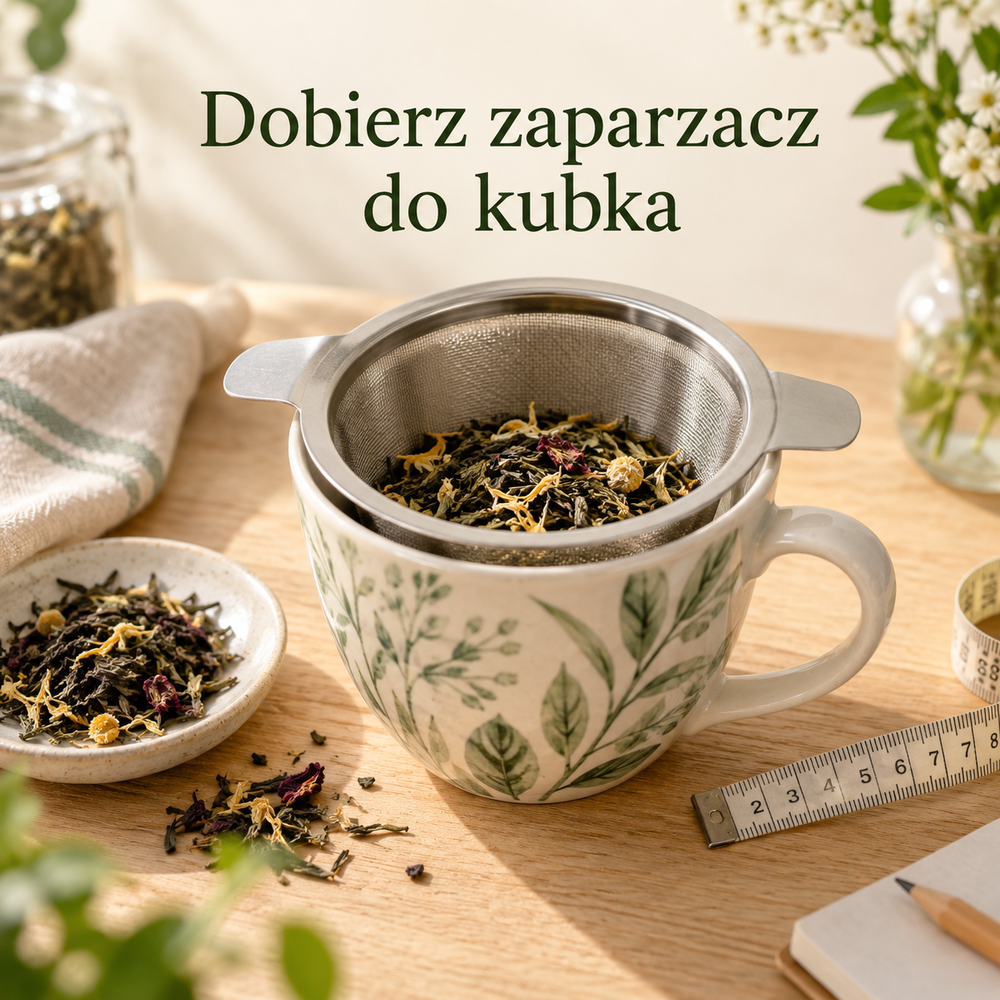
A good infuser should first and foremost give leaves room to expand freely while fitting stably into the mug. It is therefore not just about the diameter of the strainer. Its depth, volume, the way it rests on the vessel, and the type of tea you brew most often also count.
In practice, an infuser that is too small is one of the most common reasons why loose-leaf tea turns out flat, uneven, or too intense. Leaves swell upon contact with water and need space so that the water can flow between them.
In short
- For an everyday mug, it is best to choose an infuser that has the largest possible chamber for the leaves, but still rests stably on the rim of the vessel.
- The larger and more rolled the leaves, the more space they need while steeping.
- Finer tea can be brewed in a smaller strainer, provided the mesh is sufficiently fine.
- For oolongs, larger leaves, and herbs, wide baskets work better than small balls.
- Before buying, it is worth measuring the inner diameter of the mug and checking what the infuser will rest on.
Why does the size of the infuser matter?
Dry tea takes up much less space than it does after a few minutes in water. This applies especially to larger leaves, rolled teas, and blends with flowers, fruits, or herbs. Once soaked, the tea blend increases in volume, and some leaves can expand several times over.
If the infuser is small and tightly packed, water flows through the tea unevenly. The outer leaves have good contact with the water, while those squeezed in the center unfold more slowly. The result can be an infusion with less distinct aroma or the need to extend the steeping time.
Therefore, when choosing a tea infuser, it is worth looking not only at whether it fits into the mug, but above all at the space available for the leaves.
How to measure a mug before choosing an infuser?
The most important thing is the diameter of the mug's opening. Measure it from the inner edge to the inner edge. Then check if the chosen infuser has handles, a rim, or ears that will rest on the vessel.
The dimension of the strainer alone does not always tell the whole story. Two infusers with a similar diameter can have completely different capacities if one is shallow and the other deep. For a larger portion of tea or for leaves that significantly increase in volume, a deeper basket will usually be more comfortable.
What to pay attention to?
- Mug diameter - the infuser should not fall inside or sit unstably.
- Depth - the bottom of the strainer should be in the water at a normal fill level of the mug.
- Basket volume - free space is needed around the leaves.
- Mesh size - finer tea leaves require a finer mesh.
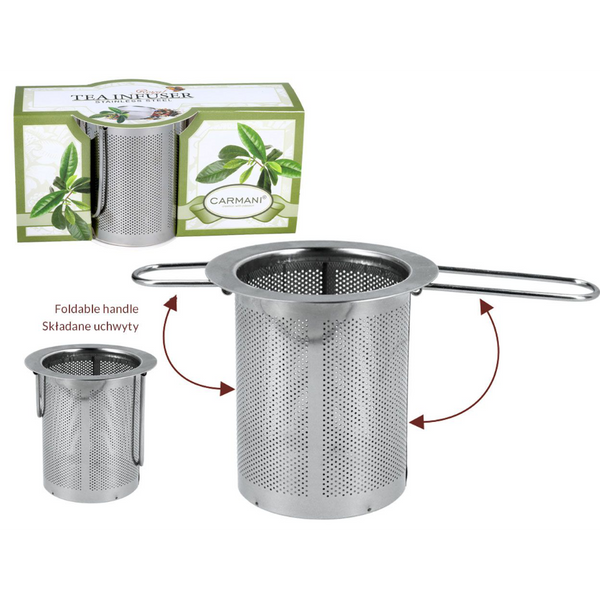
- Removal method - a handle or rim makes it easier to finish steeping at the perfect moment.

How large of an infuser for 250, 350, and 500 ml mugs?
There is no one universal diameter assigned to a specific mug capacity, as vessels vary in shape. A 350 ml mug can be short and wide or tall and narrow. Therefore, treat the mug's capacity as a guideline, not the only parameter.
| Vessel capacity | What to pay attention to | Practical choice |
|---|---|---|
| approx. 250 ml | small amount of tea | small or medium strainer, if leaves have room |
| approx. 300-350 ml | typical everyday mug | medium or large basket with room for leaves to expand |
| approx. 400-500 ml | larger portion of infusion | large and deep basket, especially for loose-leaf teas |
If you are hesitating between two sizes and both fit the mug, it is usually safer to choose the larger chamber. Extra space does not harm the tea, whereas too little space may limit leaf expansion.
Which infuser for fine tea?
For fine tea leaves, the mesh density becomes the most important factor. A very large basket with wide openings may let fragments of leaves into the infusion. On the other hand, it is not worth choosing a miniature infuser just because the tea itself is fine.
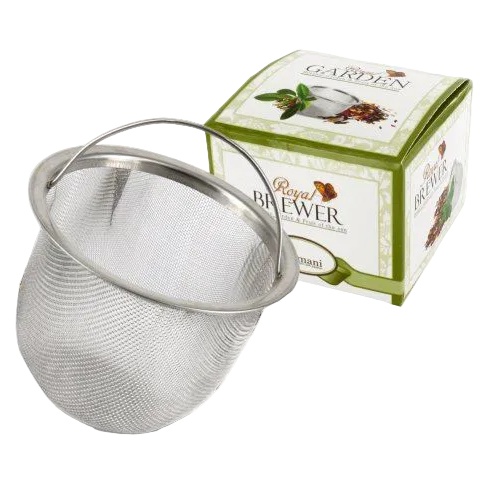
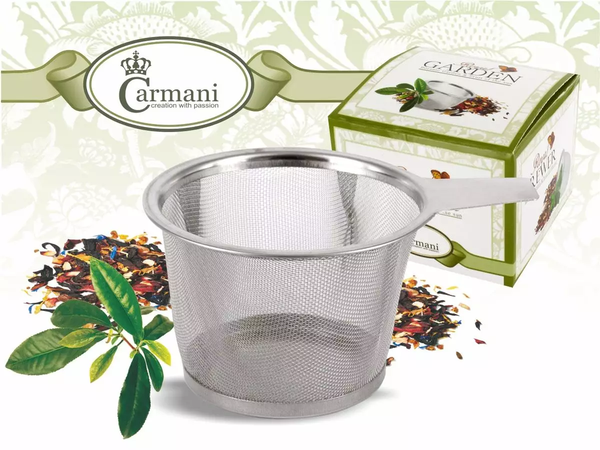
A good compromise is a strainer with a larger surface area and fairly fine mesh. An example is the Carmani strainer with handle, which allows you to separate the leaves from the infusion without confining them to a very small space.
Which infuser for large leaves and oolong?
Large leaves need much more space. This is especially evident in the case of some Oolong teas, whose leaves can be tightly rolled and expand significantly during steeping.
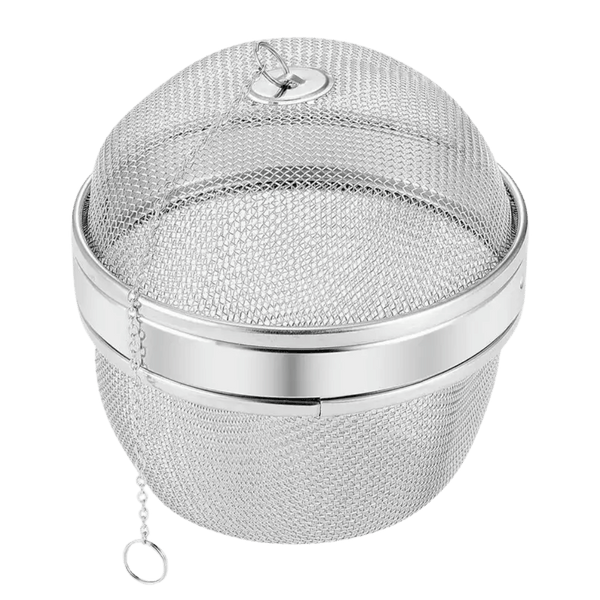
For such teas, a small metal ball is often not the best choice. The leaves can fill it almost completely even before the steeping is finished. A wide basket or strainer where the tea has contact with water from many sides will be better.
The same principle applies to large black, green, and white tea leaves. If you remove the strainer after steeping and see a solid block of leaves pressed firmly against the sides, it is worth trying a larger infuser.
Which infuser for herbs and fruit blends?
Herbal and fruit blends can have very different structures. They may contain light leaves, flowers, larger pieces of fruit, roots, or spices. In such a case, a large chamber is particularly practical because it allows the water to flow freely around the ingredients.
If you often change the type of infusion, it is worth choosing a universal solution rather than buying the smallest possible infuser. One well-fitted basket can work for both classic tea and most herbs.
Ball, tongs, or basket?
Each type has its application, but they differ in the amount of space for the leaves.
- A small ball is compact and convenient for small amounts of finer tea.
- Tongs are quick to use but usually offer limited space.
- A basket gives the leaves the most room and works well for daily steeping of loose-leaf teas.
- A strainer with a handle can be a good compromise between convenience and a large steeping surface.
For a smaller mug, you can also choose a compact model, such as the Faco mug infuser 4.8 cm x 5 cm, but before purchasing, always compare its dimensions with your own vessel and the type of tea you plan to brew.

How much tea should you put in the infuser?
The size of the infuser does not mean you have to fill it completely. On the contrary, a larger infuser should leave free space, not encourage you to increase the dosage.
Adjust the amount of tea to the water volume and the recommendations for the specific product. If you need a stronger infusion, it is usually better to slightly increase the amount of tea rather than significantly extending the steeping time. However, still leave room for the leaves to expand.
How to check if your infuser is too small?
Look at the leaves after steeping. If they are heavily compressed, pushing against the lid, or forming a tight cylinder matching the shape of the infuser, it is a clear sign that they have too little room.
Other signs include uneven taste, the need to stir the leaves during steeping, or a large difference between the first and subsequent steepings of the same tea. Switching to a larger strainer is a simple test. If the infusion becomes more aromatic and consistent, the problem may have been the chamber being too small.
Most common mistakes when choosing an infuser
- Buying only based on appearance. A decorative infuser can be very small inside.
- Failure to measure the mug. Even a good model can be unstable in an unusual vessel.
- Filling the strainer to the brim. Dry tea leaves need extra space after soaking.
- The same small infuser for every tea. Large leaves and rolled oolongs have different requirements than finer teas.
- Ignoring the mesh size. Openings that are too large will let particles through, and extremely fine ones may hinder water flow with very fine tea.
FAQ
Is a larger infuser always better?
If it fits stably in the mug, more space usually helps the leaves expand freely. However, this does not mean you have to choose the largest model on the market. A comfortable fit for the vessel is what counts.
Can the infuser touch the bottom of the mug?
It can, if its construction is intended for that and it does not cause instability. It is more important that most of the tea remains submerged under the water surface.
Is a small ball suitable for loose-leaf tea?
Yes, but best for small amounts of finer leaves. With large or heavily rolled leaves, it can quickly run out of space.
How do you know if the strainer has the right mesh?
There should be few particles left in the mug after steeping. If a lot of tea passes through the strainer, choose a model with a finer mesh.
Is a larger infuser needed for a 500 ml mug?
Usually yes, because a larger portion of tea is used for more water. However, the most important thing is maintaining free space around the leaves.
Is one infuser enough for different teas?
For most home uses, yes. A universal, wide basket with sufficiently fine mesh will work for many types of teas and herbs.
Summary
The best infuser size is one that fits stably in the mug and leaves clear space for the leaves. Before purchasing, measure the diameter of your vessel, pay attention to the depth and mesh of the strainer, and think about which teas you brew most often.
If you drink mainly larger loose-leaf teas, oolongs, or herbs, choose more spacious baskets. If you use finer tea, the mesh density will be more important. In our infuser collection, you can compare different designs and choose a model for your mugs and daily brewing method.