akcesoria do herbaty
Which herbal and tea infuser [should I choose]? Do you need two different infusers?
Do you need two different infusers for herbs and tea? Find out when one universal model is enough and what size, mesh, and material to choose.
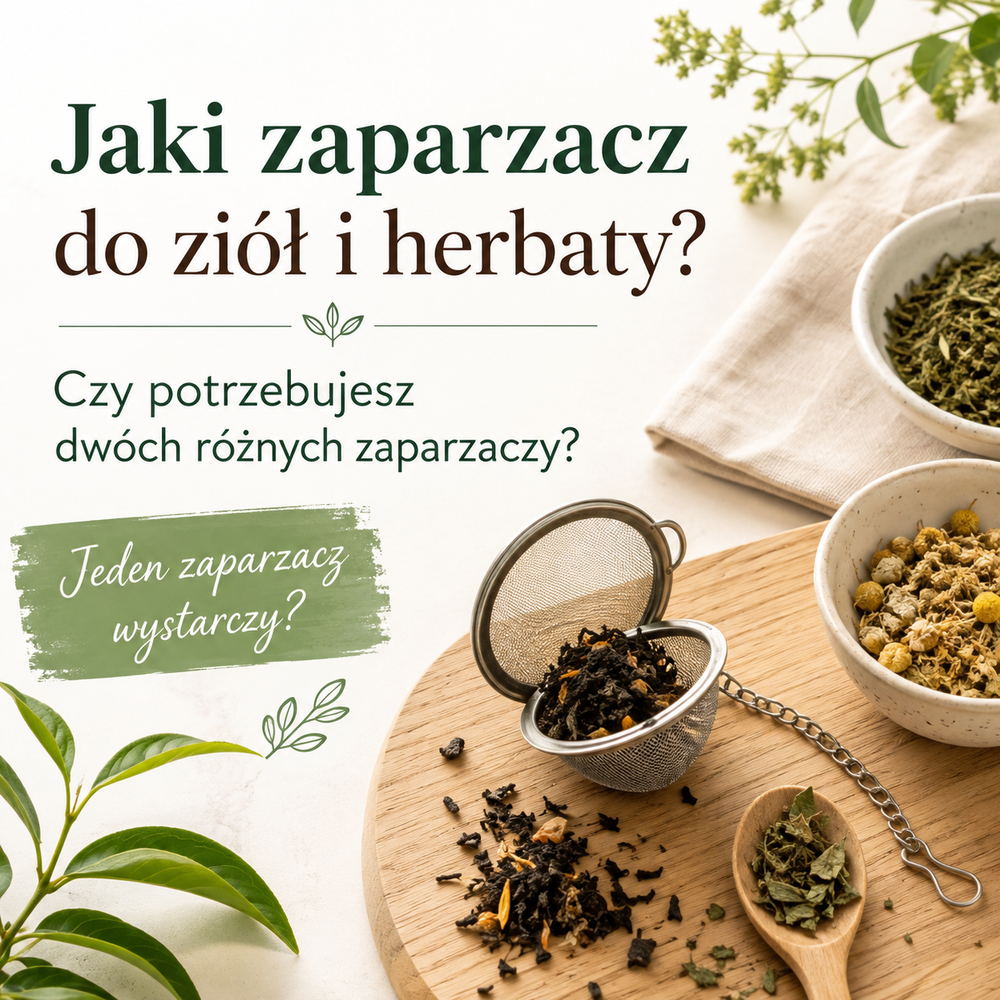
You typically don't need two separate infusers for herbs and tea. One well-chosen, capacious infuser with a fine mesh screen is sufficient for most loose-leaf teas and herbal blends. A second model only makes sense if you frequently brew very aromatic herbs and spices, want to avoid scent transfer, or simply prepare two different infusions simultaneously.
The most versatile choice is a basket or mesh infuser, which gives leaves plenty of room and also retains finer dried particles. In practice, more important than the label "for tea" or "for herbs" are the chamber size, mesh density, material, and ease of cleaning.
If you're just choosing an accessory, check out the current collection of tea infusers. Below, we explain what to look for so that one model can also handle herbs effectively.
In brief
- One infuser can be used for both loose-leaf tea and herbs.
- The most versatile option is a spacious basket with a fine mesh.
- Plenty of space is important for expanding tea leaves and large herb pieces.
- A fine mesh helps retain small fragments of mint, lemon balm, rooibos, spices, and other blends.
- A separate infuser should be considered for very intensely scented ingredients, if the aroma lingers on the material.
- After each use, empty and wash the infuser thoroughly, especially after herbs and spice blends.
Is one infuser enough for tea and herbs?
Yes. For most home uses, one good infuser is entirely sufficient. Loose-leaf tea and dried herbs differ in appearance, size, and how they behave in water, but both primarily need free contact with water and effective separation of the dried material from the finished infusion.
There is no technical rule stating that tea and herbs must be prepared in separate accessories. What is much more important is whether the chosen infuser:
- accommodates an appropriate amount of dried material without tightly compressing it,
- has mesh holes fine enough for the blends being used,
- fits the mug or teapot,
- is easy to empty and clean,
- does not make it difficult to remove the dried material after brewing.
If these conditions are met, the same model can be used for green tea in the morning, black tea in the afternoon, and a herbal blend in the evening.

How does brewing tea differ from brewing herbs from an infuser perspective?
The differences mainly concern the structure of the dried material. In tea, we can have large, twisted leaves, finer fragments, or leaves rolled into balls. Herbal blends often contain leaves, flowers, stems, seeds, peels, and very fine fragments simultaneously. This means a universal infuser should be able to handle a greater variety of sizes.
Loose-leaf tea needs space
Many teas expand in volume when they come into contact with water. This is particularly noticeable with larger leaves and rolled teas. If the chamber is small, the leaves can be compressed, and the water flow through the dried material restricted.
Therefore, a wide basket that takes up a significant portion of the mug is convenient for loose-leaf teas. You don't have to fill it to the brim. Its advantage is precisely the free space around the dried material.
Herbs can be more finely crushed
Herbal blends often contain small fragments that can pass through large openings. If you regularly reach for herbal teas, pay attention to a fine mesh or perforation. This reduces the amount of particles that get into the infusion.
A small amount of sediment does not necessarily indicate a problem with the quality of the infusion. It is often simply the result of very finely crushed material. However, if you want the clearest possible drink, a denser mesh will be more practical.
Aromatic ingredients can leave a scent
Mint, intense spices, citrus peels, or strongly flavored blends can leave a distinct scent on some materials. Promptly emptying the infuser and washing it thoroughly after use usually helps. If, despite cleaning, you notice that the scent transfers to delicate teas, then a separate infuser for highly aromatic infusions might be a convenient solution.
What type of infuser is most versatile?
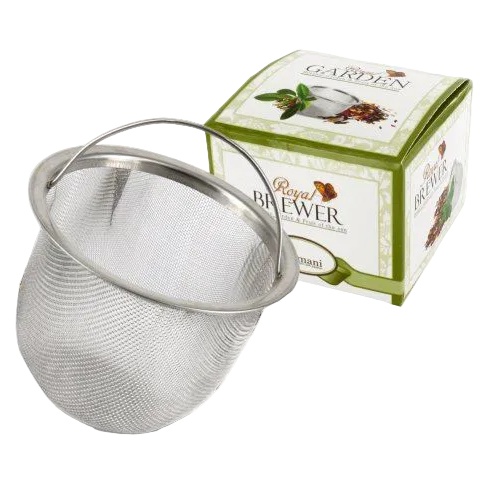
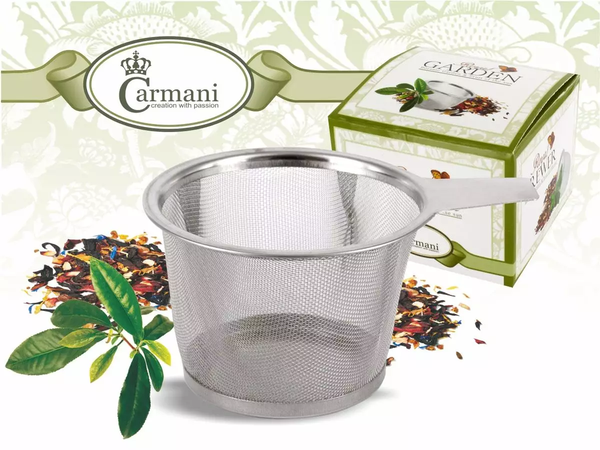
If you want to buy one model for everything, the safest choice is a large basket infuser with a fine stainless steel mesh. Such a design combines ample space for leaves with good filtration of fine dried material.
A good example of a design engineered for both uses is the Finum universal infuser with lid for tea and herbs. It has a fine stainless steel mesh, a wide chamber, and a lid that can serve as a drip tray after brewing. This type of construction shows what to look for even when comparing several different models.
Basket infuser or large mesh strainer
This is the most versatile option. It works well with large leaves, finer teas, and most herbal blends. It's also easy to remove the entire infuser from the mug at a specific moment to stop the brewing process.
It's worth paying attention to the diameter. The basket should rest stably on the rim of the vessel, but also go deep enough so that the dried material is well submerged.
Ball infuser
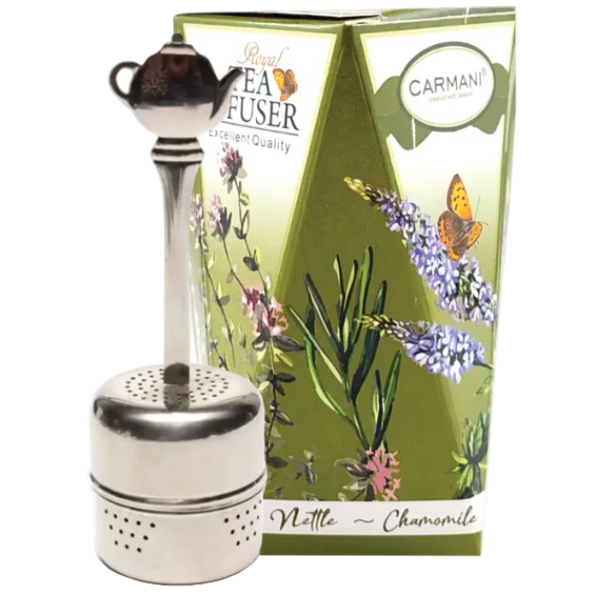
A ball infuser is small, simple, and convenient for small portions. Its limitation is less space. For large leaves or voluminous herbs, the dried material can be heavily compressed. For finer tea or a small amount of herbs, it may be sufficient, but as the sole infuser for very different infusions, it is usually less versatile than a basket.
Silicone infuser
Silicone models are lightweight and often come in interesting shapes. When choosing, however, you must primarily look at the size of the chamber and the holes. A small infuser might work well for one type of tea but poorly for dried material that significantly expands in volume. If such a model has large holes, small fragments of a herbal blend can get into the mug.
French press or larger vessel
For larger quantities of infusion, a vessel where the dried material has a lot of space and is then separated from the water can be convenient. This solution makes particular sense when preparing several cups at once. For a single mug, a large basket is usually simpler to use and quicker to wash.
What to look for when buying one infuser for everything?
1. Chamber size
The more diverse teas and herbs you drink, the more useful a large chamber is. In practice, it's better to choose a model that's a bit larger than too cramped. A large basket doesn't interfere with a small portion of dried material and offers freedom when brewing large-leaf tea.
2. Mesh density
Fine mesh increases versatility. It retains small leaves and blend fragments while not hindering the brewing of larger leaves. If you mainly drink large-leaf teas, very fine holes aren't necessary, but they quickly prove practical for herbs.
3. Material
Stainless steel is a popular choice because it is durable and easy to clean thoroughly. Glass and ceramic are also neutral materials, although they are less commonly found in classic basket infusers. Silicone is light and practical, but after very intense blends, it's worth checking if any scent has lingered on it.
4. Easy removal from the mug
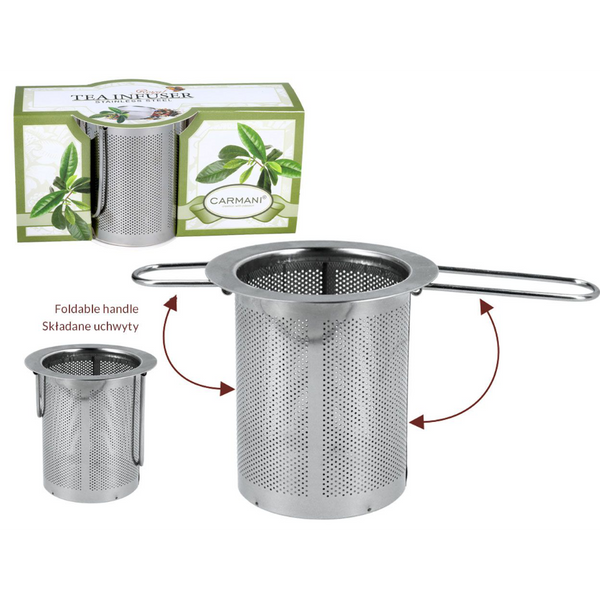
A good infuser should have a handle, rim, or other element that allows it to be safely removed after brewing. This lets you control the brewing time without pouring the infusion into another vessel.
5. Lid or drip tray
A lid is particularly useful for longer herbal infusions, as it helps retain heat. If it can double as a drip tray after removing the infuser, it's easier to set down a wet basket without messing up the countertop.
6. Compatibility with your mug
Even a great infuser will be inconvenient if it doesn't fit your vessel. Check your mug's diameter and the range on which the infuser rests. If you prefer a ready-made set, mugs with infusers are an alternative, where the elements are already matched.
When is it worth having two separate infusers?
A second infuser isn't a necessity, but in a few situations, it genuinely simplifies life.
- Very aromatic blends. If you frequently brew strong mint, spices, or intensely flavored blends, and then delicate white or green teas, a separate model can reduce the risk of lingering scents.
- Two infusions simultaneously. If one person drinks tea and another drinks herbs, two infusers are simply more convenient.
- Very different types of dried material. You might have a large basket for leaves and herbs and a small model for fine, quick portions.
- Different places of use. One infuser can stay at home, and another at work. This is often a more practical reason than the mere division into tea and herbs.
However, if you want to limit the number of accessories, start with one larger mesh strainer. Only after a few weeks of use will you know if you genuinely need a second model.

Does a herbal infuser need a finer mesh?
Not always, but it's a common advantage. Herbal blends can be more finely crushed than classic loose-leaf teas. A fine mesh will retain more small fragments, especially flowers and crushed leaves.
If you use large pieces of dried material, such as whole leaves or larger root fragments, a very dense mesh is not essential. However, a universal model should also be able to handle finer ingredients, so it's worth choosing smaller mesh holes than in a typical metal ball with large openings.
Can a tea infuser be too small?
Yes. This is one of the more common problems when brewing loose-leaf tea. If the leaves fill the entire chamber and are heavily compressed after soaking, it's worth switching to a larger model. This problem also applies to some herbs that are light and voluminous before being steeped.
A larger infuser doesn't mean you need to use more dried material. It's about providing space around the leaves. If you want to compare constructions more broadly, see the guide Ranking of tea infuser types - which one to choose?.
How to use one infuser for herbs and tea without mixing flavors?
Regular cleaning is most important. After brewing, don't leave wet dried material in the strainer for many hours. Empty the infuser, rinse it under running water, and wash it according to the recommendations for the specific material.
For a stainless steel infuser, pay special attention to the fine mesh and the joints where particles of dried material might collect. If you don't detect the scent of the previous infusion after washing, there's no practical reason to separate the accessories.
However, if after a very aromatic blend the scent persists despite thorough washing, you can dedicate that model to herbs and buy another for more delicate teas. Such a division should stem from experience, not from the rule that each type of infusion requires separate equipment.
What set is most practical to start with?
For most people, a simple set will suffice:
- one wide basket infuser with a fine mesh,
- a mug or teapot that the infuser fits stably into,
- a timer on your phone to control brewing time,
- optionally, a second infuser only when a real need arises.
This solution is cheaper, takes up less space, and allows you to test in practice what you truly need. Instead of buying a separate accessory for each category of beverage, it's better to start with one model with the widest possible application.
FAQ
Can you brew tea and herbs in the same infuser?
Yes. One well-cleaned infuser can be used for both loose-leaf tea and most herbs. The most versatile is a spacious model with a fine mesh screen.
Is a separate infuser needed for mint?
No. A separate infuser for mint is only needed if an intense aroma lingers in it after washing, which interferes with brewing more delicate teas.
What infuser is best for fine herbs?
A model with a fine mesh or dense perforation will be most convenient. It helps limit the amount of small dried fragments entering the infusion.
Is a ball infuser suitable for herbs?
Yes, if the portion of dried material fits freely inside and the holes are not too large. For voluminous herbs or large leaves, a larger basket might be more convenient.
Is a metal infuser good for herbs?
Yes. A stainless steel infuser is durable, easy to wash, and can work well for both herbs and tea. The size and density of the mesh are primarily important.
Can a silicone infuser be used for herbs?
It can, but it's worth checking the chamber size and the holes. For very fine dried material, larger holes may allow more particles to pass into the infusion.
Does a larger infuser brew tea better?
A larger infuser gives the leaves more space and is usually more versatile. However, this doesn't mean you need to use more dried material. The chamber size and the amount of tea are two separate parameters.
When should I buy a second infuser?
You should consider buying a second model if you frequently prepare two infusions simultaneously, need a different mesh size, or if intense aromas linger on the first infuser despite thorough cleaning.
Summary
For tea and herbs, one good infuser is usually enough. The most versatile will be a wide basket with a fine mesh, which provides space for large leaves and simultaneously retains small fragments of herbal blends.
Don't buy two models just because one infusion is called tea and the other herbal. Start with one practical infuser, ensure thorough cleaning, and only decide whether a second one is truly needed based on your daily use.
If you want to compare available designs, check out the infusers available in the store and choose a model primarily based on your mug size, type of dried material, and how you most frequently prepare infusions.