kubek z zaparzaczem
Infuser balls vs. baskets: which work better?
An infuser ball is small and convenient, but a basket gives the leaves much more room. Check which type of infuser best suits the tea you use and your brewing method.
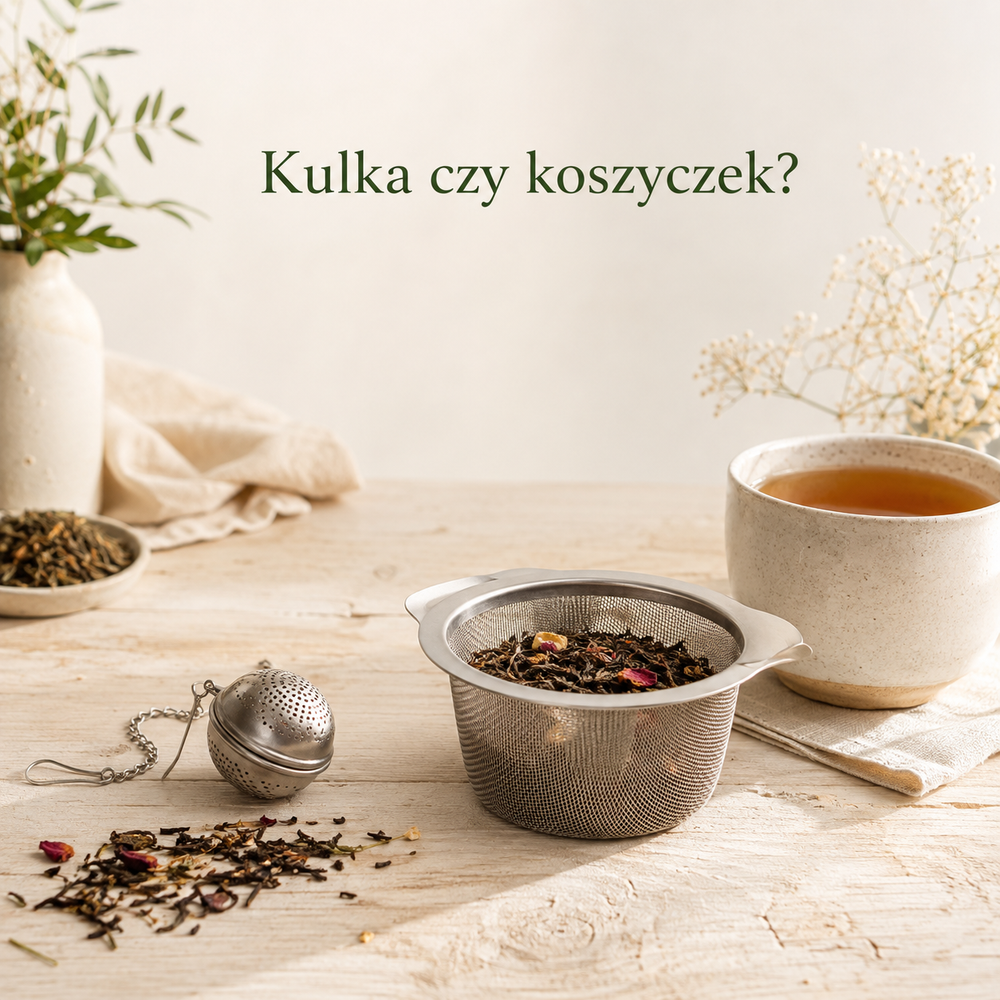
A basket infuser will usually work better for brewing loose leaf tea because it gives the leaves more room to expand and allows for a freer flow of water. A tea ball is smaller, cheaper, and more convenient for travel, but it works best with finer tea leaves and small portions of tea.
Choosing an infuser might seem like a minor detail, but its shape and capacity have a real impact on the taste of the prepared brew. An infuser that is too small restricts the leaves from expanding, which can result in weaker, less aromatic, or unevenly brewed tea.
Most often, the choice comes down to two solutions: a small ball or egg infuser, and a larger basket infuser that sits in a mug. You can find both types in the tea infusers category.
In short
- A basket infuser gives leaves more room and usually ensures more even brewing.
- A tea ball is compact, inexpensive, and easy to take to work or travel with.
- For large leaves, oolongs, white teas, and fruit blends, a basket infuser is better.
- A tea ball may suffice for finer black and green teas.
- Not only the shape, but also the size of the infuser, the density of the mesh, and its fit to the mug are most important.
Key takeaway: If you care most about the quality of the brew, choose a basket infuser. If a small form and easy portability are most important, a tea ball may be sufficient.
What is a tea ball infuser?
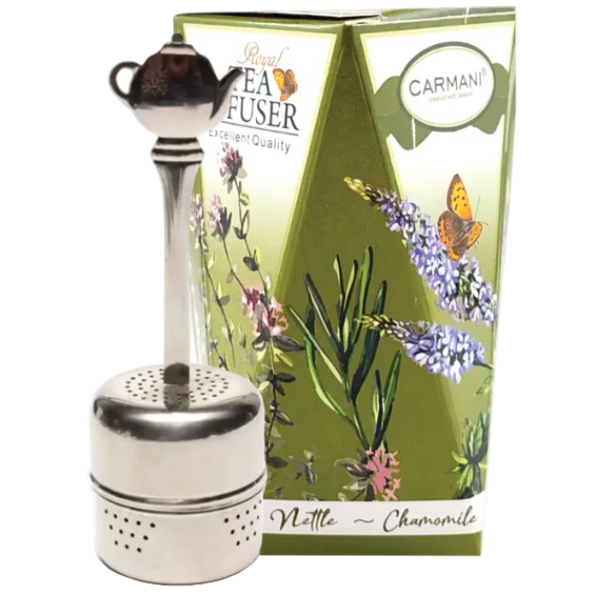
A tea ball infuser is a small, usually metal container with holes or a fine mesh. It can be shaped like a ball, an egg, a teapot, or another decorative form. It usually opens into two halves; you put the tea leaves inside, close it, and immerse it in a mug.
To suspend the infuser, a chain, hook, or silicone handle is most often used. Thanks to its small size, the tea ball can be easily stored and carried around.
An example of such a solution is the egg-shaped infuser with a handle, which works well for preparing a single cup of tea.
Main advantages of a tea ball
A tea ball infuser is a good choice for people who:
- brew a single cup of tea,
- primarily use fine tea leaves,
- are looking for an inexpensive accessory,
- need an infuser for work or travel,
- have little kitchen space.
Its great advantage is its simplicity. Filling it with tea leaves takes a moment, and after brewing, the ball can be removed from the mug and placed on a saucer.
What are the limitations of a tea ball?
The biggest limitation is the small amount of space inside the infuser. Dry leaves increase in volume when they come into contact with hot water. If the tea ball is filled almost to the brim, the leaves will not be able to expand freely.
Limited water flow can lead to uneven brewing. The outer layer of leaves will have better contact with water than the tea leaves in the center.
The problem is particularly evident with:
- large white tea leaves,
- rolled oolong leaves,
- whole green tea leaves,
- blends with large pieces of fruit,
- herbs, flowers, and spices.
So, a tea ball is not a bad infuser, but it requires appropriate tea leaves and sensible filling.
What is a basket infuser?
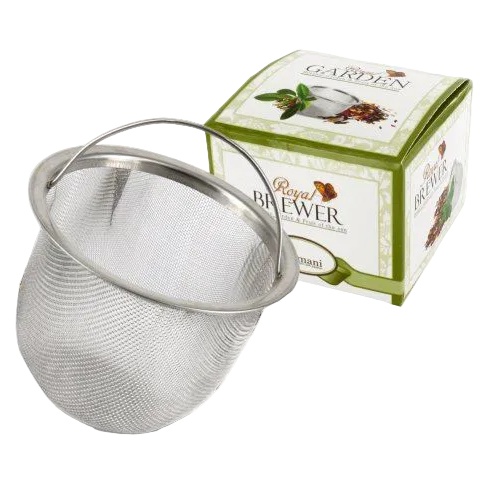
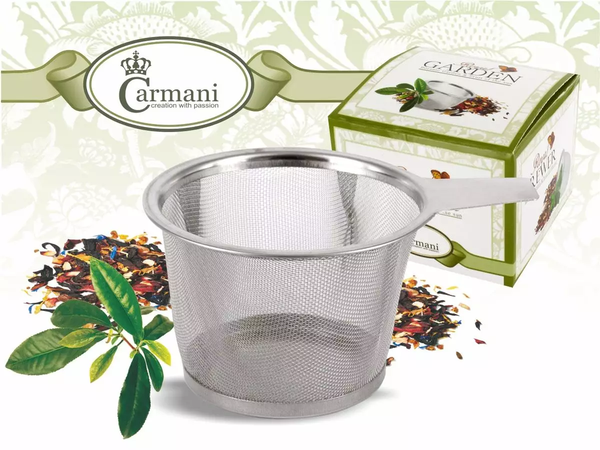
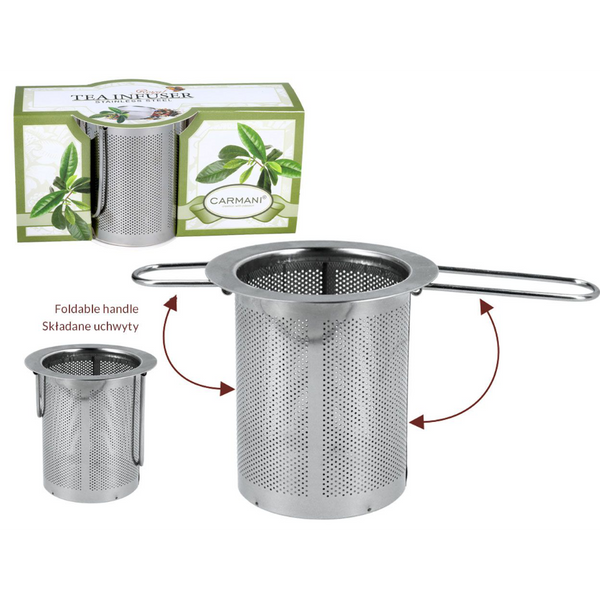
A basket infuser is a larger infuser, cylindrical in shape or a wide mesh. It is placed directly into a mug, cup, or teapot. It usually has a wide upper rim, handles, or protrusions that allow it to rest stably on the vessel.
The biggest advantage of a basket infuser is its spacious interior. Leaves can freely expand in it, and water flows through the tea from many sides.
Basket infusers are also often built into ready-made mugs with infusers. Such a solution allows tea to be brewed without having to choose a separate mesh to match the diameter of the vessel.
Why does a basket infuser make better use of tea leaves?
In a larger basket infuser, water has better access to the entire portion of leaves. The tea is not compressed in a small space, allowing the aroma, color, and flavor to be released more evenly.
This is particularly important for good quality loose leaf teas, whose leaves often expand several times their original size during brewing.
A basket infuser also makes it easier to observe the leaves and control the amount of tea used. After brewing, it can be quickly removed, reducing the risk of an overly strong or bitter brew.
Tea ball vs. basket infuser: comparison of key features
| Criterion | Tea Ball Infuser | Basket Infuser |
|---|---|---|
| Space for leaves | Limited | Ample |
| Water flow | More restricted | Freer |
| Large leaves | Can compress them | Excellent choice |
| Fine tea leaves | Good if holes are small | Good with dense mesh |
| Fruit and herbal blends | Often too small | Usually more convenient |
| Cleaning | Tea leaves can get stuck in the closure | Usually easier |
| Storage | Takes up very little space | Larger |
| Travel and work | Very convenient | Convenient, but less compact |
| Brewing control | Good | Very good |
| Versatility | Medium | High |

Why is space for leaves so important?
Tea should not be treated like a powder that simply needs to be immersed in water. During brewing, dry leaves absorb water, expand, and gradually release the compounds responsible for flavor and aroma.
The larger the leaves, the more space they need. In a small tea ball, they can form a compact layer that water struggles to penetrate.
This doesn't mean the infuser needs to fill the entire mug. However, it should be large enough so that after adding the tea leaves, there is still plenty of empty space inside.
Practical tip: Do not fill the tea ball to the brim with tea. If the leaves completely fill the interior and are tightly packed after brewing, consider using a smaller portion or a larger infuser.
When will a tea ball infuser be sufficient?
A tea ball can function well if you brew finer teas and want a simple, compact accessory.
Fine black teas
Black teas with smaller or broken leaves do not expand as significantly as large, rolled oolong leaves. A small tea ball can therefore provide sufficient space for them, provided it is not overfilled.
Finer green teas
A tea ball can work well for finer green tea leaves. However, it's worth paying attention to the size of the holes. Perforations that are too wide can allow small particles into the brew.
A single cup at work
A small infuser is easy to fit in a desk drawer, bag, or tea container. If you prepare one cup of tea daily, a tea ball will be a quick and inexpensive solution.
You can find more solutions for use outside the home in the guide on portable tea infusers for work and travel.
When is it better to choose a basket infuser?
A basket infuser will be a better choice wherever the tea leaves need more space or contain large ingredients.
Oolong teas
The leaves of many oolong teas are tightly rolled. During brewing, they gradually open, so they need significantly more space than they occupy in their dry state.
White teas
White teas often consist of large, light leaves and buds. It is difficult to place an adequate portion in a small tea ball without compressing it.
Fruit and herbal blends
Dried fruits, petals, flowers, herbs, and spices have irregular shapes. A basket infuser allows for more convenient measurement of the blend and facilitates water flow between its ingredients.
Re-steeping leaves
If you steep the same portion of leaves more than once, a basket infuser is particularly convenient. You can remove it, place it on a lid or saucer, and then return it to the vessel.
Does the type of mesh matter?
The size of the infuser is not everything. The construction of its walls is equally important.
Fine mesh
A fine steel mesh retains small fragments of leaves, herbs, and spices. It is a good choice for blends containing fine tea leaves.
However, a very dense mesh may require more thorough rinsing, as small particles can get stuck in the openings more easily.
Perforated metal sheet
Infusers made of perforated steel are durable and easy to clean. If the holes are quite large, more small particles may pass into the brew.
Steel and silicone
Stainless steel is durable, neutral, and resistant to high temperatures. Silicone often appears in handles or decorative elements of the infuser. The most important thing is that the accessory is food-safe and convenient for daily cleaning.

How to choose the right infuser for your mug?
The basket infuser should rest stably on the rim of the vessel and not fall inside. Before purchasing, it is worth checking:
- the diameter of the mug opening,
- the depth of the vessel,
- the width of the basket infuser's handles,
- the possibility of covering the mug during brewing,
- the space needed to safely remove the infuser.
For those who don't want to match a separate mesh, a mug sold together with an infuser and lid might be suitable. An example is the Lavender porcelain mug with infuser.
A broader discussion of both solutions can be found in the article Mug with infuser or classic mug? Which to choose for daily tea drinking?
Which infuser will work best for a teapot?
For preparing several cups of tea, a small tea ball will usually be too cramped. A larger amount of tea leaves requires a proportionally larger space.
The most convenient solution is a wide basket infuser fitted to the teapot or a teapot with a removable infuser. It allows you to prepare a larger batch and remove the leaves once the desired flavor is achieved.
In the category of glass teapots, you can find models that allow you to observe the color of the brew and the expansion of the leaves.
For daily brewing of a larger portion, a 750 ml glass teapot with a separate infuser might be suitable.
How to choose the right infuser?
A good infuser should primarily match the way you most often prepare tea.
Choose a tea ball if:
- you mainly prepare one cup,
- you use finer tea leaves,
- you are looking for a low price,
- you need a small infuser for work,
- you want to store the accessory with your tea.
Choose a basket infuser if:
- you brew whole leaf teas,
- you reach for oolongs and white teas,
- you prepare fruit and herbal infusions,
- you want even brewing,
- you often re-steep the same leaves,
- you want to easily separate the tea leaves from the finished brew.
Choose a mug or teapot with an infuser if:
- you want a set of matching components,
- you regularly drink loose leaf tea,
- you don't want to measure the diameter of a separate mesh,
- you prepare tea for yourself as well as for several people.
Common mistakes when using an infuser
Overfilling the tea ball
Too large a portion of tea leaves will not improve the taste if the leaves are compressed. It's better to use a larger infuser than to fill a small tea ball to the brim.
Choosing holes that are too wide
For fine tea leaves, a denser mesh is needed. Otherwise, particles of leaves will get into the brew.
Leaving the infuser in the mug
Leaving the leaves in water for too long can lead to an overly intense, astringent, or bitter taste. The infuser should be removed after the appropriate brewing time.
Inadequate cleaning of hinges and mesh
Fragments of tea leaves can remain in the tea ball's closure and the fine mesh of the basket infuser. It's best to rinse the infuser immediately after use and dry it thoroughly.
Choosing an infuser based solely on appearance
A decorative shape does not always mean good functionality. First and foremost, it's worth checking the capacity, mesh density, closing mechanism, and ease of cleaning.
FAQ
Is a tea ball infuser good?
A tea ball is a good infuser for finer leaves and single servings. You should leave some empty space inside so the tea can expand during brewing.
Why does a basket infuser brew tea better?
A basket infuser gives the leaves more space and allows for freer water flow. This allows the tea to brew more evenly.
Is a tea ball suitable for green tea?
A tea ball can be suitable for finer green tea if it's not overfilled. For large, whole leaves, a spacious basket infuser will be better.
Which infuser to choose for oolong?
For oolong, it's best to choose a large basket infuser or a wide infuser in a teapot. Rolled oolong leaves need a lot of space to expand during brewing.
Which infuser is best for fruit teas?
For fruit teas, a basket infuser with a fine mesh usually works best. It can accommodate large pieces of fruit while retaining smaller fragments of the blend.
Is a stainless steel infuser safe?
A stainless steel infuser designed for food contact is a durable and practical solution. It should not be damaged, rusted, or covered with flaking coating.
Can a basket infuser be used in any mug?
Not every basket infuser fits every mug. Before purchasing, you need to check the diameter of the vessel, the width of the infuser, and how it rests on the rim.
How to clean a tea ball infuser?
After use, the tea ball should be opened, the tea leaves removed, and the interior, holes, and hinge thoroughly rinsed. The infuser should dry completely before being stored.
Which infuser will be best for work?
For work, a small tea ball, an egg infuser with a handle, or a mug with a fitted basket infuser are convenient. A tea ball takes up less space, while a basket infuser provides better conditions for the leaves to expand.
Is it worth buying a mug with an infuser?
A mug with an infuser is worth choosing if you regularly prepare single servings of loose leaf tea. The fitted basket infuser and lid make it easy to control the entire brewing process.
Summary: tea ball or basket infuser?
For most loose leaf tea lovers, a basket infuser will be a better and more versatile choice. It provides more space for the leaves, facilitates water flow, and works well with both classic teas and fruit or herbal blends.
A tea ball infuser still has its uses. It is small, inexpensive, and easy to take to work or travel with. It is best used with finer tea leaves and should not be filled completely.
Before purchasing, it's worth considering not only the appearance of the infuser, but primarily the type of tea you usually choose, the size of the portion, and the method of preparing the brew. See available tea infusers and choose a solution tailored to your daily ritual.