akcesoria do herbaty
How to use a tea infuser: 7 mistakes that make your tea taste worse
How to use a tea infuser? Learn the correct brewing method and 7 common mistakes that result in a weak, bitter, or uneven brew.

A tea infuser has one basic task: to allow water to flow freely around the leaves, and after an appropriate time, to enable quick separation of the dried leaves from the infusion. In practice, these two things most often determine whether the tea will be clean, aromatic, and well-balanced, or too weak or excessively tart.
The most common problem is not that someone chooses a "bad" infuser model. More often, small habits are to blame: overfilling the strainer, leaving the leaves in the water for too long, or using a very small infuser for large leaves. Below you will find a simple way to use an infuser and seven mistakes worth eliminating.
In short
- add enough dried leaves so that after swelling, the leaves still have room,
- match the infuser to the cup so that most of the leaves are submerged in water,
- time from the moment the tea is steeped,
- remove the infuser after brewing,
- do not press large leaves into a small ball just because they fit dry,
- after use, quickly empty and rinse the strainer so that residue does not dry in the holes.
How to correctly use a tea infuser step by step?
- Choose the right portion of dried leaves. For many teas, a good starting point is about 2-3 g per 250 ml of water, but the instructions for a specific product may recommend different proportions.
- Put the leaves into a clean infuser. Do not pack them tightly and leave room for expansion.
- Place the infuser in a cup or teapot. After pouring water, the dried leaves should be in an area where water flows freely.
- Pour water at the appropriate temperature. The temperature depends on the type of tea.
- Start a timer. This makes it easy to replicate a successful brew.
- Remove the infuser when the time is up. This stops further extraction.
- Empty and rinse the infuser. Fresh leaves are much easier to remove than dried ones.
For daily brewing, you can choose from various infusers. The most important thing is not the decorative form, but whether the model fits the vessel and gives the leaves enough space.

Mistake 1: The infuser is too small for the leaves
Dry tea can look unassuming, but many leaves noticeably increase in volume after contact with water. If the strainer is almost full to the brim before steeping, after a few minutes the leaves can become tightly compressed.
Water then has difficulty reaching the entire portion of dried leaves. The effect can be uneven: some leaves release their flavor intensely, while others remain less thoroughly moistened. This is particularly visible with larger, twisted leaves.
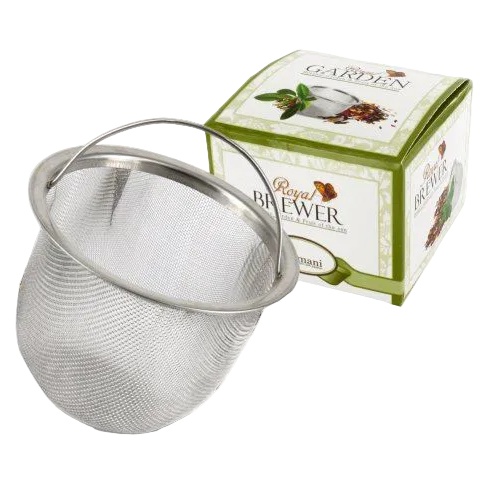
For such teas, baskets and wide strainers are convenient. An example is the Alden tea and herb infuser, 7 cm diameter, whose size can easily be matched to the diameter of the cup used.
Mistake 2: You put too much tea in
More dried tea does not always mean a better brew. If you use a very large portion and maintain the same time and temperature, the tea may become too intense, tart, or heavy.
The problem is especially noticeable in small infusers, as it further limits the space for the leaves. It's better to start with a moderate portion and increase it incrementally with the next brew if the infusion is too light.
If you want to improve the taste, change one parameter at a time. First the amount of dry leaves, the time, or the temperature, not all three simultaneously.
Mistake 3: You leave the infuser in the cup for the entire time you're drinking
Leaves don't stop steeping just because you stopped looking at the clock. If the infuser remains in the water, extraction continues. An infusion that was well-balanced after three minutes can become much stronger after another few minutes.
Therefore, after the set time has elapsed, it's best to remove the entire strainer. This is one of the biggest advantages of an infuser compared to leaving loose leaves at the bottom of the cup.
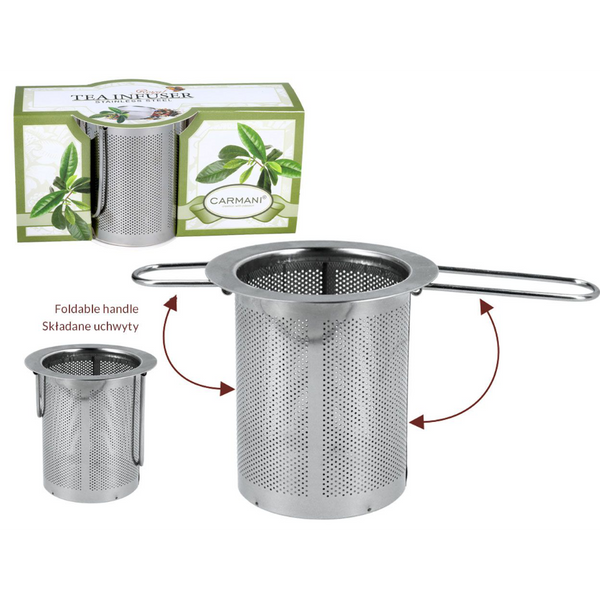
A practical solution is also a cup with an infuser, where after brewing you can remove the insert with the dried leaves and continue to drink the infusion without further extraction.
Mistake 4: You use the same temperature and time for every tea
An infuser is just a tool. It doesn't replace adjusting brewing parameters to the type of leaves. Black tea usually tolerates higher temperatures better than delicate green tea, and finely ground leaves can release flavor faster than large, whole leaves.
If the tea turns out bitter or very tart, before changing the infuser, check the water temperature and brewing time. If it's too weak, don't immediately assume you need more dry leaves. The cause could be water that's too cool or brewing that's too short.
Mistake 5: You pack or squeeze the leaves in the infuser
There's no need to compact tea to fit more in. Infusing works best when water can reach the entire surface of the dry leaves. Tightly packed leaves have less space to unfurl.
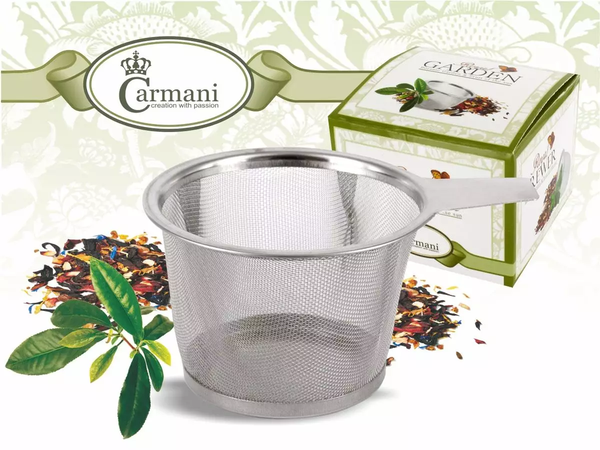
If the portion doesn't fit, a simpler solution is a larger strainer or less tea. For everyday use, for example, the Carmani infuser strainer with handle works well; it's a classic strainer form that allows you to observe how the leaves behave during brewing.
Mistake 6: The infuser is poorly matched to the water level
Even a large strainer won't help if the dried leaves are mostly above the water surface. This can happen with a very shallow vessel, a small amount of infusion being prepared, or an infuser suspended too high.
After pouring, observe for a moment whether the leaves are actually submerged and whether the water flows freely around the dried leaves. You don't need to stir the infusion continuously. It's enough that the infuser's design and the amount of water allow for even contact.
Mistake 7: You postpone cleaning the infuser until later
Wet leaves are easy to remove quickly. Once dry, they can stick to the mesh and block tiny holes. This not only makes cleaning difficult but can also restrict water flow in subsequent brewings.
After each use, discard the dried leaves, rinse the infuser thoroughly, and let it dry. If a dark film appears, the method for a more thorough cleaning should be matched to the infuser's material. Metal, silicone, plastic, and ceramic may require slightly different treatment.

Do you need to stir the tea in the infuser?
There's usually no need for vigorous stirring. If the strainer is adequately sized, the leaves are submerged, and the water has space to flow, the infusion will prepare itself without constant agitation of the dried leaves.
A gentle movement of the infuser at the beginning can help moisten light leaves floating on the surface. However, do not squeeze the dry leaves or press them hard with a spoon against the mesh.
What to do with the infuser after the first brew?
If the tea is suitable for re-steeping, after removing the strainer, you can set it aside on a clean saucer or coaster and prepare another infusion later. Do not continuously pour water over the leaves just because they are still in the infuser. Subsequent steeping should be a conscious decision with a new timing.
If you're not planning another brew, remove the leaves immediately and rinse the strainer. This way, the infuser is ready for its next use, and no fragments of dried leaves remain in the fine mesh.
Which infuser is easiest for beginners?
For many people, the simplest is a wide basket or strainer that can be easily removed from the cup. Such a design facilitates time control, gives the leaves space, and allows for quick assessment of whether the portion of dried leaves is too large.
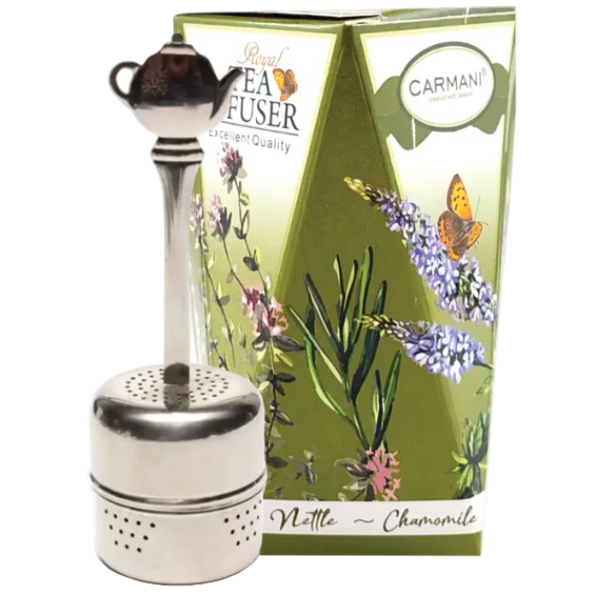
Small balls, tongs, or decorative infusers can also work well, especially with finer dried leaves. You just need to match the amount of tea to the available space. There is no single best model for everything.
How to improve your brew without buying a new infuser?
Before changing your accessory, try three simple things:
- add a little less dry tea to give the leaves more room,
- remove the infuser exactly after the specified time,
- check if the water covers the entire portion of tea.
If, after these changes, the infusion is still uneven and the leaves form a compact mass inside after brewing, then a larger strainer may indeed improve convenience and consistency.
FAQ
Do I need to remove the infuser after brewing tea?
Yes, if you want to stop the extraction at your chosen moment. Leaving the leaves in the water means the infusion continues to change and can become too strong.
How much tea should I put in the infuser?
For many teas, a starting point is about 2-3 g of dried leaves per 250 ml of water. However, the exact amount depends on the type of product and the manufacturer's recommendations.
Can the infuser be completely filled with leaves?
After brewing, it may look fuller than at first, but it's not worth tightly filling a dry infuser. Leaves need space to expand and come into contact with water.
Does a metal infuser change the taste of tea?
A good quality, clean accessory designed for food contact should not dominate the taste of the infusion. If you notice an unusual smell, first thoroughly wash and rinse the infuser.
Can one infuser be used for different teas?
Yes. A single, well-cleaned infuser can be used for many types of teas. It's advisable to rinse it thoroughly after strongly flavored blends so that the scent does not transfer to more delicate infusions.
Why is tea in a small ball infuser weak?
One reason could be that the leaves are packed too tightly. If the dried leaves are heavily compressed after brewing, try a smaller portion or a larger infuser.
Do I need to clean the infuser after every use?
Yes. Removing the leaves and thoroughly rinsing after each brew prevents residue from drying and helps maintain the strainer's clear flow.
Summary
Good infuser usage boils down to a few repeatable actions: a reasonable portion of dried leaves, space for the leaves, proper temperature, controlled time, and removing the strainer after brewing. Most taste problems can be improved without over-complicating the entire ritual.
If your current infuser squeezes the leaves or doesn't fit your cup, compare available infusers and choose a model that gives the dried leaves more space and can be easily removed after brewing.