herbata liściasta
Can you mix different loose-leaf teas? How to create your own tea blends
Can you combine black tea with green, fruit, or spices? We explain how to choose teas and proportions, and how to create your own blend step by step.
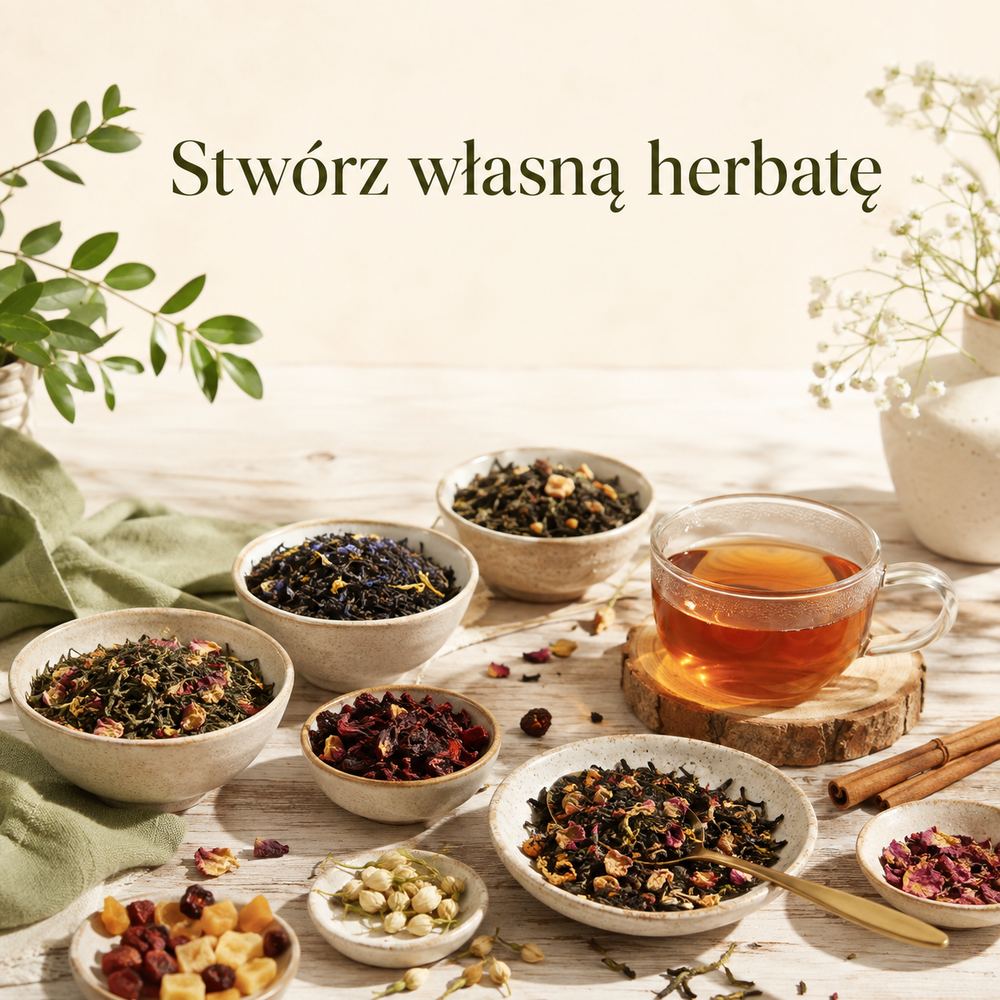
Yes, different loose leaf teas can be mixed. Teas with similar brewing parameters are the easiest to combine, for example, two black teas or two green teas. You can also combine different types of teas, fruits, flowers, herbs, and spices, but it is then worth paying attention to the proportions, as well as the temperature and brewing time.
Creating your own tea blends allows you to match the taste of the brew precisely to your preferences. You don't need specialized equipment for this. To start, two teas, a small scale, and a few test portions will suffice.
If you are just looking for a suitable base, it is worth starting with loose leaf teas without a large number of additives.
In short
- different loose leaf teas can be mixed,
- it's easiest to start with teas of the same type,
- a good initial proportion is about 70-80% base tea and 20-30% of the second ingredient,
- strong spices and intense additives should be dosed much more carefully,
- the first blends are best prepared in portions of 10-20 g,
- if the ingredients require completely different brewing parameters, they can be brewed separately and combined only as ready infusions.
Can different types of tea be mixed?
You can combine both teas of the same type and completely different ones.
The simplest example is mixing two black teas. One can provide a stronger base, and the other a more delicate or aromatic character. Similarly, you can experiment with different green teas.
A good starting point for such experiments are loose leaf black teas.
Combinations such as these require a bit more attention:
- black tea + green tea,
- green tea + white tea,
- black tea + oolong,
- green tea + fruit blend,
- tea + rooibos,
- tea + herbs or spices.
The problem is not the combination of ingredients itself, but their different optimal brewing conditions.
Can black and green tea be mixed?
Yes, but it's not always the easiest blend to start with.
Black tea usually tolerates higher water temperatures well, while green tea can become excessively bitter if brewed with water that is too hot.
If you want to combine both types, you can:
- use an intermediate temperature,
- use a small proportion of green tea,
- brew both teas separately and combine the ready infusions.
The third method allows for greater control over the taste.
For experiments with a green base, it's worth choosing classic loose leaf green teas.
How to start creating your own tea blend?
The simplest rule is: first choose the base, and only then the additives.
The base can be tea:
- black,
- green,
- white,
- oolong,
- rooibos,
- fruit.
Initially, it's best to choose products without flavor additives. This makes it easier to observe how the second ingredient actually affects the infusion.
In the store, you will find a separate collection of teas without additives, which works well when looking for such bases.
What black tea is suitable as a base?
A classic tea with a distinct but not overly flavored profile is a good solution.
An example is Basilur Gold 100g, which is a classic black Ceylon tea. It can be used as a starting point for experiments with other teas or additives.
What green tea is suitable for blending?
For green tea, it's good to start with a simple profile without additional flavors.
An example is Basilur Sencha Tea 100g. A more neutral base makes it easier to assess the impact of the second ingredient on the entire composition.

How to choose the proportions for your own blend?
There is no single ideal proportion. However, a good starting point is to maintain a clear dominance of one tea.
| Blend element | Initial proportion | Role |
|---|---|---|
| base tea | 70-80% | main character of the infusion |
| second tea | 20-30% | change of flavor profile |
| intense additives | a few percent | aromatic accent |
| delicate flowers or fruits | according to taste | complement to the composition |
For example, you can prepare a 10g blend consisting of about 7g of one tea and 3g of another.
After brewing, evaluate primarily:
- which ingredient dominates,
- if any aroma is imperceptible,
- if the infusion is not too bitter,
- if the taste remains clear after cooling.
Only then change the proportions.
Most important conclusion: when creating your own tea, it's worth changing only one element at a time. If you simultaneously change the composition, proportions, amount of dry tea, and brewing time, it will be difficult to determine what actually improved the taste.
What teas blend well together?
To start, it's worth choosing relatively predictable combinations.
Black tea + black tea
This is one of the easiest variations.
You can combine a stronger black tea with a more delicate one, or teas from different regions. Since they usually have similar brewing requirements, preparing the blend is simple.
Green tea + green tea
An equally good choice for beginners.
For example, you can combine a more herbaceous tea with a milder and less pronounced variety.
Black tea + fruit tea
This is an interesting way to create a more fruity composition.
However, it's worth starting with a small amount of fruit blend, as hibiscus, fruits, and flavors can quickly dominate the base.
Green tea + fruit
Such combinations often result in light and fresh compositions. Notes that work well include:
- citrus,
- peach,
- strawberry,
- raspberry,
- pineapple.
Ready-made compositions can also be found in the teas with additives collection, which can serve as inspiration when creating your own blends.
Tea + spices
You can also experiment with:
- cinnamon,
- cardamom,
- ginger,
- cloves,
- orange peel.
Here, proportions are particularly important. A small amount of spice can completely change the character of the blend.
A good example of how intense spices can harmonize with black tea is Basilur Masala Chai 100g. The ready-made composition can be used as inspiration before creating your own version.

Can ready-made flavored teas be mixed?
Yes. You can, for example, combine two ready-made flavored teas, but the result becomes less predictable.
If one tea contains fruits, the other spices, and both additionally have their own aromas, the blend may have too many competing notes.
Therefore, for the first attempts, the rule is better:
one simple base + one distinct flavor direction.
Instead of mixing three very complex compositions, combine classic black tea with one fruity tea.
An example of a tea showing such a combination is Basilur Cranberry 100g, where black tea has been combined with a cranberry character.
How to make your own tea blend step by step?
1. Choose a base tea
For the first attempt, choose black or green tea without additives.
2. Choose only one direction
It can be:
- another tea,
- fruit,
- flower,
- spice,
- herb.
Do not start with five or six ingredients.
3. Prepare a small portion
10-20g is perfectly sufficient.
If the blend turns out to be unsuccessful, you won't waste a large amount of good tea.
4. Write down the proportions
Don't measure everything "by eye" only.
If you prepare a great blend, without written proportions, recreating it later can be difficult.
5. Brew according to the requirements of the most delicate ingredient
This is especially important for green and white teas.
6. Taste the infusion also after it has cooled slightly
Temperature affects the perception of aroma and taste. What seems well-balanced immediately after brewing may present differently after a few minutes.
7. Adjust only one parameter
For example, increase the proportion of the second tea from 20% to 30%.
This way, you know exactly what effect the change had.
How to choose ingredients for your own blend?
It's easiest to be guided by the flavor profile.
If you're looking for a more distinct composition, choose black tea as the base.
If you want a lighter profile, green tea can be a good starting point.
If you're primarily interested in fruit additives, you can use a small proportion of a fruit blend to complement a classic tea.
Simple blending rule
You can think of a blend as having three levels:
Base: the main flavor.
Character: the second ingredient that gives direction.
Accent: an ingredient used in a small quantity.
Example:
black tea + orange + a touch of cinnamon
Not every level has to be present. A blend of two good teas can be just as interesting.
Is it better to mix dry leaves or prepared infusion?
Both methods are correct, but they serve slightly different purposes.
Mixing dry tea leaves
It is more convenient if the ingredients have similar brewing conditions.
Once the appropriate proportions are established, you can prepare a larger batch of the blend and store it together.
Mixing infusions
It is better when teas require different temperatures or brewing times.
For example, you can brew black and green tea separately, then combine the infusions in a 70:30 ratio.
This ensures that each tea is prepared under its optimal conditions.
What mistakes to avoid when blending teas?
Adding too many ingredients
More is not always better. With six intense ingredients, it's hard to pinpoint the dominant flavor.
Preparing a large batch right away
Always do a test first.
Ignoring brewing temperature
This is particularly crucial when combining black and green tea.
Adding too many spices
Cloves, cinnamon, or ginger can quickly overpower a blend.
Not writing down the recipe
Your own blend is much more useful if you can recreate it later.
Using moist additives
For a blend intended for storage, choose properly dried food ingredients. Moisture should not get into the container with dry tea.
How to choose teas for your first custom blend?
If you're just starting, choose:
- one pure black or green tea,
- one additional flavor,
- a proportion of about 80:20,
- a test batch of about 10-20g.
It will be easiest to start with the loose leaf teas category, then narrow down the choice to black, green, or teas without additives.
Recommended teas for experimenting
Basilur Gold 100g
Classic black tea that can be used as a base for initial experiments.
Basilur Sencha Tea 100g
A proposal for those who want to start blending based on green tea.
Basilur Masala Chai 100g
A ready-made example of combining black tea with a more intense spicy direction.
Basilur Cranberry 100g
An example of combining black tea with a distinct fruity note.
FAQ
Can two different loose leaf teas be mixed?
Yes. The easiest way is to mix teas with similar brewing parameters, such as two black or two green teas. This makes it easier to prepare an infusion without compromises regarding temperature and time.
Can black tea be mixed with green tea?
Yes, but black and green tea may require different brewing parameters. You can use an intermediate temperature or brew both teas separately and combine the ready infusions.
In what proportions should teas be mixed?
A good starting point is about 70-80% base tea and 20-30% of the second ingredient. Then, the proportions can be changed after subsequent tastings.
Can fruits be added to loose leaf tea?
Yes. For a dry blend intended for storage, it is best to use properly dried food ingredients.
Can tea be mixed with spices?
Yes. Cinnamon, cardamom, ginger, or cloves can create interesting compositions, but they should be used sparingly, as they can easily dominate the tea's flavor.
Can ready-made flavored teas be mixed?
You can, although the outcome is less predictable than with a pure base. To start, it's better to combine a simple tea with only one distinct flavor profile.
How much of your own blend should you prepare for a trial?
About 10-20g is sufficient for the first tasting. A small batch allows for experimenting with proportions without using up a large amount of tea.
Can a custom blend be prepared in advance?
Yes, if all ingredients are dry and suitable for storage together. The ready blend should be protected from moisture, light, and strong odors.
Summary
Mixing different loose leaf teas is a simple way to discover new flavors. The best results initially come from combining one classic tea with a second, well-defined ingredient.
Start with a small portion, write down the proportions, and change one element at a time. Over time, you can move from simple two-tea blends to more elaborate compositions with fruits, flowers, and spices.
If you want to prepare your first custom composition, check out the available loose leaf teas and choose a simple base to start your experiments.